Showing posts with label C05 (PhotoAnomalies). Show all posts

5.32 How come famous photographers claim that the Apollo photos are fake?

IN A NUTSHELL: They’re famous photographers, but they’ve always worked on Earth. They have no experience of photography in space, where lighting and lunar soil reflectivity are very different from Earth. Moreover, they were asked to judge digitally altered versions of the photographs instead of the original scans, which show none of the alleged inconsistencies. In one case they were even shown a fake (a montage) instead of a real Apollo photo and they didn’t notice that it lacked the famous crosshairs that characterize all moonwalk photos.


THE DETAILS: In his video American Moon (2018), Massimo Mazzucco argues in favor of several conspiracy theories by consulting experienced photographers: Toni Thorimbert, Aldo Fallai, Oliviero Toscani, Nicola Pecorini and Peter Lindbergh. Mazzucco himself is a photographer. These photographers set forth several technical objections that lead them to claim that the Apollo photographs are fake.

  • Radiation. It is claimed that deep space radiation should have fogged the Apollo films. The photographers support this claim by noting that X-ray machines used in airports would fog their films unless they were shielded in lead containers. But this comparison is wrong, for the reasons already discussed in detail in Section 8.5: the intensity of radiation in space is nowhere near that of an X-ray scanner. It’s like comparing a breeze and a hurricane. Besides, if radiation actually fogged films in deep space, then it should have fogged the films used in the uncrewed American and Russian probes that visited the Moon (Lunar Orbiter 1-5, 1966-67; Luna 3, 1959; Luna 12, 1966). It didn’t.
  • Temperatures. The photographers report their experience with extreme temperatures, noting that freezing cold or great heat would cause their cameras to jam due to thermal expansion and contraction and that their film would become brittle in deep cold. However, their experience is Earth-based. They are used to working in an atmosphere, which becomes cold or hot and conducts cold and heat by contact; this does not happen in the vacuum of space, as described in detail in Section 8.6. Once again, if this claim were true, then the cameras would have jammed and the films would have become brittle in the already mentioned Russian and American uncrewed lunar probes as well. They didn’t.
  • Non-parallel shadows. This claim has already been discussed in Section 5.6; the photographers, probably because they’re not familiar with the lunar environment, don’t appear to consider the possibility that the surface of the Moon might have hollows or rises that alter the apparent direction of shadows.
  • Backlighting. The photographers claim that astronauts and spacecraft photographed in shadow or with backlighting on the Moon should be completely dark. This objection, too, has already been analyzed in Section 5.18 and Section 5.5: in vacuum and in air, backlighting works in the same way and shadows receive light reflected off nearby sunlit surfaces.
  • Hotspots and fall-offs. As already discussed in Section 5.17, the unusual nature of lunar soils tends to produce a brighter glow in the central region of a photograph. This happens in photos taken on the Moon by Chinese probes as well. Moreover, the exhaust of the landing rocket blasts away the surface dust in the areas it strikes, changing the reflectivity of the ground. These photographers are not familiar with lunar geology and with the details of the Apollo missions; they are unaware of these peculiarities and accordingly try to explain them by referring to the studio lighting techniques that they know, speculating that NASA used a spotlight that was able to cover only the central region of the ground. They don’t stop to ask themselves why NASA should have been so penny-pinching as to use an inadequate spotlight instead of a more powerful one that would light up everything well and evenly from a distance.

In summary, these well-known photographers are experts in terrestrial photography and their artistic and technical talent is undisputed on Earth. But they have no experience in space and they are not familiar with the unusual characteristics of the space environment (such as a black sky in full daylight on the Moon, with no light scattered by the atmosphere as occurs on Earth). Accordingly, it is understandable that they reach wrong conclusions.

Their mistake is even more understandable if they are given heavily processed photographs or even fakes. The pictures shown to them by Mazzucco in fact have an artificially exaggerated contrast, and one of them is a montage.

For example, Mazzucco shows them this well-known photograph, and they reply that it must be false because of the fall-off of light in the foreground and background:

Figure 5.32-1. Photo AS11-40-5903 in the version shown by American Moon.


However, this version has a much higher contrast than the original scan, and this exaggerates the small differences in ground brightness. The alleged hotspots and fall-offs are essentially digital artifacts.

Contrast exaggeration is often used for aesthetic purposes, as shown by Figure 5.32-2 (which is not as exaggerated in contrast as the version used by Mazzucco); the actual brightness variations are very small, as shown by the unprocessed scan of Figure 5.32-3.

Figure 5.32-2. Photo AS11-40-5903, processed for higher contrast and more solid blacks.


Figure 5.32-3. Unprocessed scan of photo AS11-40-5903.


The full set of Apollo 11 EVA photographs is available online in processed and unprocessed form.

There’s more. Mazzucco asks Thorimbert, Toscani, Fallai and Lindbergh to examine the picture shown in Figure 5.32-4 and they reply that it’s fake because of its inconsistent lighting.

Figure 5.32-4. Toni Thorimbert criticizes a photograph in American Moon.


None of these expert photographers, however, realize that this is not an actual Apollo photograph: it’s a montage (Figure 5.32-5), already discussed in Section 5.27. None of these experts notice obvious clues, such as the lack of crosshairs and the fact that the Sun has been added digitally with typical computer graphics effects (a 1960s camera would never produce such circular lens flares).

Even more importantly, this montage was created by combining photographs taken with different settings for the areas in shadow areas and for the areas in full sunlight, and therefore creates a misleading perception of the lighting conditions that the photographers have been asked to assess.

Figure 5.32-5. A montage created in 2008 by Ed Hengeveld.


In other words, Massimo Mazzucco asked the photographers whether the lunar photographs are false by giving them a false photo to examine. Their answer is not surprising.


5.31 Why is there a man in a waistcoat in a photo taken on the Moon?

IN A NUTSHELL: It’s not a man in a waistcoat: it’s astronaut Harrison Schmitt, wearing a spacesuit. His image is distorted by being reflected in Gene Cernan’s curved visor.


THE DETAILS: It is claimed that one of the Apollo photographs shows a long-haired man in a waistcoat standing on what appears to be the surface of the Moon. This claim was reported by British tabloid The Mirror and by many other news sources in 2017.*

* US moon landing FAKED? Photo of astronaut’s visor ‘PROVES NASA staged Apollo 17 mission’, by Jeff Farrell, The Mirror, 18 November 2017, archived at Archive.is and Archive.org; Newsweek; Fox News; Maxim; IB Times; Newsline; Mirage News; Russia Today; Dunyanews Pakistan.


Figure 5.31-1. The “man in a waistcoat” report in The Mirror (2017).


The Mirror reports this as a “shock photo” that “appears to show a man walking around the 'moon' without a space suit during the US's Apollo 17 mission [...] [A] close-up analysis of one supposed image from the famous expedition that emerged this week suggests the whole enterprise was filmed on a Hollywood movie set.”

The source of this discovery is, according to The Mirror, a Youtube user known as Streetcap1, who reportedly claims that "It looks like a man. Back in the early 70s. Long hair. Wearing some sort of waistcoat type thing.”

As always, one has to wonder why the hypothetical conspirators would be so colossally clumsy as to leave a picture of a man without a spacesuit in the Apollo photographs.

The detail of the alleged “man in a waistcoat” shown by the tabloid is in Figure 5.31-2.

Figure 5.31-2. The alleged “man in a waistcoat” in The Mirror (2017).


The original Apollo 17 photograph from which this detail is taken is AS17-141-21608 (Figure 5.31-3). The Apollo Lunar Surface Journal and the NASA description of this photo report that it was taken at 165:17:01 of mission elapsed time, during the third EVA, by astronaut Harrison Schmitt and shows his crewmate Gene Cernan.

Figure 5.31-3. NASA photograph AS17-141-21608.


The alleged long-haired man can be glimpsed in the top left corner of the photograph, in the reflection of Cernan’s gold visor. It’s a very small and blurry detail, even in the best scans available online (Figure 5.31-4, Flickr; Nasa.gov; Archive.org), so it takes quite a lot of imagination to see a “waistcoat” or “long hair”.

Figure 5.31-4. The “man in a waistcoat” in the best available scan of AS17-141-21608.


Comparing the Mirror and NASA versions of this detail reveals that the tabloid’s picture has been processed to enhance its contrast, and this always produces digital artifacts, i.e., apparent details that didn’t actually exist in the original subject.

In the unprocessed NASA version, the person no longer appears to be wearing a waistcoat: the two dark bands on his body are, somewhat more plausibly, the shadow of his arm and of his upper body. The alleged long hair is simply the suit helmet.

The person’s shadow, moreover, is too oddly shaped to belong to someone who is not wearing a spacesuit; its shape makes sense, however, if the person is wearing a large backpack, such as the portable life support system (PLSS) carried by Apollo astronauts.

There’s another important detail: the person is reflected exactly in the part of the surface of the spherical visor that is at right angles to the observer, as can be seen in Figure 5.31-5.

Figure 5.31-5. A detail of NASA photograph AS17-141-21608.


This is possible only if the person is taking the photograph. If you try to take a picture of a curved reflective surface, such as a road mirror or theft prevention mirror in a shop, you inevitably end up being reflected in the region where the surface is perpendicular to you.

The most logical explanation, therefore, is that the person is simply Harrison Schmitt, the other astronaut who was on the Moon with Cernan and took the photograph.

Incidentally, this claim had already been made and debunked at least as far back as 2010 (Figure 5.31-6).

Figure 5.31-6. A 2010 debunking of the “man in a waistcoat” claim.


5.30 Why is there a fake photograph of Alan Shepard on the Moon?

IN A NUTSHELL: Because it’s a montage used originally in an autobiography of two astronauts, Deke Slayton and Alan Shepard, to illustrate Shepard’s golf session on the Moon. No good footage of the event was available, so this reconstruction was used in the book. Unfortunately, it was not captioned to clarify that it was a montage. It is not included in NASA’s official catalog of lunar photographs.


THE DETAILS: The picture shown in Figure 5.30-1 appears to be a photograph of astronauts Alan Shepard and Ed Mitchell at a very special moment of their lunar excursion during Apollo 14: Shepard has attached a golf iron club head to the handle of a tool and is playing golf on the Moon, live on TV, using balls that he carried in his spacesuit pocket.

Shepard actually did play golf on the Moon, but this illustration of the event is fake.

Figure 5.30-1. Alan Shepard playing golf on the Moon in a photomontage.


This image appears in the autobiography written by Alan Shepard with his colleague Deke Slayton, Moon Shot: The Inside Story of America's Race to the Moon (1994), as documented by Figure 5.30-2.

Figure 5.30-2. The undeclared montage in Moon Shot by Deke Slayton and Alan Shepard. Photo from the author’s personal collection.


This picture is not an official NASA photo and is not in the catalogs of photos taken on the Moon. It is presumably the work of a somewhat unscrupulous publisher who wanted to illustrate this unusual moment but realized that there were no good pictures of it and therefore faked one without saying so.

The only real images of Alan Shepard’s lunar golf session are in fact the ones taken from the live TV footage. Their quality is definitely not suitable for printing in a book (Figure 5.30-3).

Figure 5.30-3. A still from the TV broadcast of Shepard and Mitchell on the Moon as Shepard briefly plays golf.


Research by Fake Astropix has allowed to identify one of the real pictures used to create this montage: Apollo 14 lunar module photo AS14-66-9276, shown in Figure 5.30-4, was flipped to use it as a background. The original US flag of this photograph has been covered by a photograph of Mitchell, probably taken from photo AS14-66-9302 and likewise flipped. Shepard, the large parabolic antenna, some equipment were added, together with their shadows, and a white circle was placed in the sky, possibly to represent Earth.

Figure 5.30-4. Photo AS14-66-9276, flipped as in the montage.


Figure 5.30-5. Photo AS14-66-9302, probably used to extract the image of Mitchell.


Figure 5.30-6. Detail of photo AS14-66-9302, probably used to add Mitchell to the montage.


5.29 Does this spacewalk photo show the reflection of the movie set in the astronaut’s visor?

IN A NUTSHELL: No. It's a photo from a ground test.


THE DETAILS: A photograph circulating on the Internet is described as an image of an astronaut spacewalk, taken during the Gemini 4 flight. But the photo shows a room reflected in the mirror-like visor (Figure 5.29-1). The caption of the photo says “Hey NASA! Why is there an office reflected in your visor?”.

Figure 5.29-1. An example of the allegedly fake photograph. Credit: Fake Astropix.


However, the careful research of experts such as Ufoofinterest allow to find the original source of this photograph: it’s a still from the footage of a ground test of the suit and of the jet-propelled maneuvering unit handled by astronaut White in preparation for his spacewalk in 1965.

The full film sequence is available for example at Framepool.com, where it is clearly identified as “pre-flight test (for space walk)”. Moreover, the bare arm of a man can be seen in the sequence, revealing very clearly that this cannot have been filmed in the vacuum of space (Figure 5.29-2).

Figure 5.29-2. A still from the full footage shows a bare human arm entering the frame from the right.


The specific frame used to create the image in dispute is shown in Figure 5.29-3.

Figure 5.29-3. The original movie frame used to create the disputed image. Credit: Ufoofinterest.


Even without this patient search for the source of the image, common sense alone should make it obvious that NASA or any other government body who wanted to fake a spacewalk photograph would not have been so stupid as to leave the visor reflection in full view and hope that nobody would notice it.


5.28 Why is there a sharp dividing line between the foreground and the background?

IN A NUTSHELL: Because it’s the outline of the natural rises and hollows of the lunar terrain. The same effect occurs in desert photos taken on Earth.


THE DETAILS: Many photographs of the Moon landings show a very sharp dividing line between the terrain in the foreground and the surface in the background.

According to some conspiracy theorists, such as David P. Wozney, this is the line that divides the floor of the movie set from the flat backdrop used to simulate the lunar environment. The line, it is claimed, is revealed by sudden differences in color and sharpness.


Figure 5.28-1. Photo AS15-88-11866 (Apollo 15). On the left there is a double horizontal dividing line, which separates different colors and sharpness levels.


Figure 5.28-2. Photo AS16-117-18825 (Apollo 16).


Figure 5.28-3. Photo AS17-134-20426 (Apollo 17).


This claim, however, clashes with the fact that in many instances there are photographs taken from various viewpoints of the same lunar location. The movie trick of using backdrops (forced perspective) only works from a single viewpoint: viewed from a different location, the illusion of depth is destroyed.


Figure 5.28-4. A forced perspective backdrop in the movie Singin’ in the Rain (MGM). The corridor is actually a flat painting. Viewed from a different angle, the trick would be immediately evident.


The 16 mm film footage taken while riding the Lunar Rover shows changes in viewpoint that would be impossible on a movie set with backdrops and clearly reveals the rises and hollows of the terrain.

Figure 5.28-5. 16 mm film footage of the Lunar Rover in motion, taken during Apollo 16.


The same kind of dividing line can be seen in real panoramic views taken on Earth, such as this image showing the desert in Kenya:


Figure 5.28-6. Credit: Filiberto Strazzari.


In other words, the presence of dividing lines and sudden color difference is not necessarily evidence of the use of backdrops.

The explanation that best fits all the phenomena that can be observed in the photographs taken on the Moon is that the terrain is not uniformly flat but has rises and hollows, which naturally form dividing lines, for example along the ridge of a rise. Without familiar references (trees or houses, for example), and without the atmospheric attenuation that occurs on Earth, it’s hard to interpret these two-dimensional photographs correctly and realize that there are many undulations in the ground.

Stereo photographs of the lunar landscape instead reveal the actual shape of the terrain very clearly.


Figure 5.28-7. Stereo photograph created by Patrick Vantuyne by combining images AS16-106-17277 and 17278 (Apollo Anaglyph Galleries).


Figure 5.28-8. Photo AS16-116-18700. Without depth clues, the terrain appears quite flat and uniform.


Figure 5.28-9. This stereo image obtained by combining photos AS16-116-18699 and 18700 (USGS Astrogeology Science Center) reveals the rises and hollows of the landscape.


5.27 Why is this photo of the LM on the moon so obviously fake?

IN A NUTSHELL: Because it’s not an official photo: it’s a montage, clearly stated as such in the original source. This montage, however, sometimes is used as real even by experts and by some lunar astronauts. It is not part of NASA’s official catalog of photos taken on the Moon and NASA has never claimed that it’s authentic.


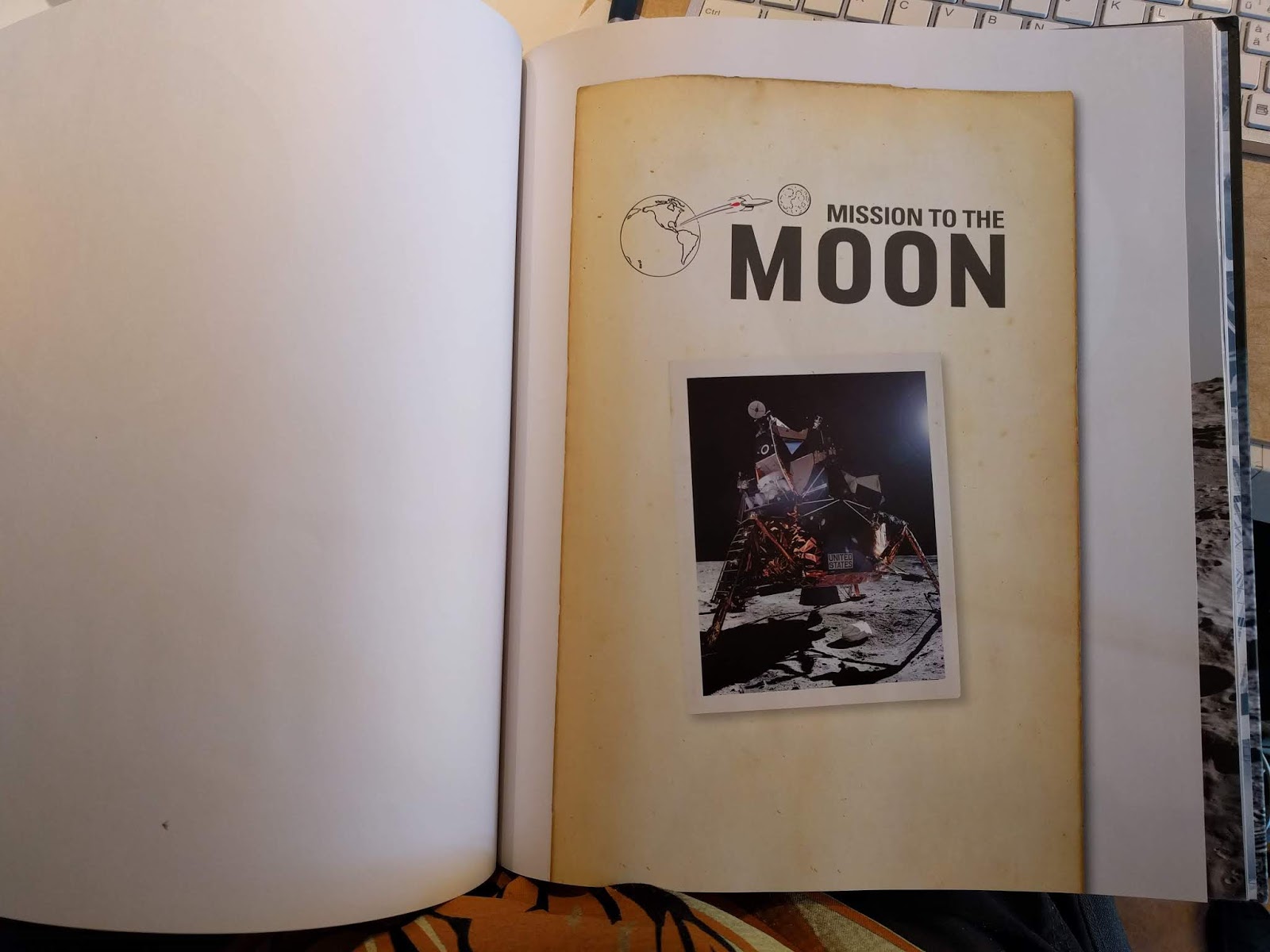
THE DETAILS: The photograph shown in Figure 5.27-1 shows the Apollo 11 lunar module on the Moon, as Buzz Aldrin gets ready to climb down the ladder to set foot on the lunar surface. It is often used in books and articles about the Moon landings. It is featured in NASA’s Apollo Lunar Surface Journal and has also been used by Apollo astronaut Walt Cunningham in his public talks.* But it’s not a real photograph.

* Mission to the Moon, Alan Dyer, Templar Publishing (2008); AstVintageSpace (Twitter.com, 2015); So haben Sie Apollo 11 noch nie gesehen, 20min.ch (2014); The Apollo 11 Moon Landing Liveblog, Gizmodo.com (2009); ALSJ, Nasa.gov; Walt Cunningham’s public talk in Tradate, Italy, 2011 (Youtube.com).


Figure 5.27-1. Composite image created by Ed Hengeveld (2008).


This photo is a montage created by Ed Hengeveld in 2008 by blending several real photographs of the Apollo 11 landing and by adding a computer-generated Sun.* But there is no intent to deceive: neither its creator nor NASA claim it to be authentic.

* The genesis of this image is explained in detail in Italian in Sì, questa foto Apollo è un falso. Ma dichiarato, ComplottiLunari.info (2015).


This montage is indeed featured in the Apollo Lunar Surface Journal, but in the section of the Journal dedicated explicitly to montages and entitled More Creativity - Fun and Inspiration. It is not included in the official catalogs of Apollo 11 photographs.

An expert observer will notice several clues that this photo is not real: it’s not square like all other Hasselblad photos taken on the Moon; there are no crosshairs (reseau marks or fiducials), whereas all the Apollo 11 photos taken outside the lunar module have them; the perspective is distorted and inconsistent; and the reflections of the sunlight on the right are not oriented correctly.

However, as time goes by and direct recollections fade, there is the risk that this kind of realistic and believable composite image, might be presented unwittingly as authentic even by people who wish to document the moon landings and even by people who were part of the Apollo program, such as indeed Walt Cunningham, and that the original, non-deceptive intent of the photograph might be lost. And of course there’s also the risk that conspiracy theorists might claim that this inadvertent use of a montage is evidence that NASA fakes its photographs.


Figure 5.27-2. The montage presented at the beginning of the book Mission to the Moon by Alan Dyer (2008) without giving any indication of its true nature. From the author’s personal collection.


5.26 Why do Aldrin’s boots shine in shadow? Are they lit by a spotlight?

IN A NUTSHELL: No. The sheen on Buzz Aldrin’s boots is not caused by a studio spotlight but by the bright sunlight reflected by Armstrong’s reflective white spacesuit as he stands in the sun. The Moon boots in museums have a dull finish because they’re worn, but they were initially coated with lubricant which made them quite shiny when brand-new and clean. Also, the contrast and brightness of the photo used to present this apparent mystery have been boosted unrealistically.


THE DETAILS: In Apollo 11 photographs AS11-40-5866 and 5869, Aldrin’s boots have a bright white highlight that looks like a reflection from a flash or a bright spotlight. This is suspicious, it is claimed, because Aldrin is standing in shadow, no flashes or studio lights were taken to the Moon, and Apollo Moon boots had a dull gray finish. Therefore, it is claimed, obtaining this kind of highlight would have required a very powerful local light source. Here is an example of the controversial reflection:


Figure 5.26-1. Detail of photo AS11-40-5866 as often circulated in Moon hoax sites (top) and as found in direct scans of the original picture (bottom).


First of all, the highlight isn’t really as bright as it appears in the top photo shown above, which is a version often used in pro-conspiracy publications and in which contrast and brightness have been exaggerated to the point of losing all shadow detail. The bottom photo shows the same detail, but taken (without processing) from the high-resolution scan publicly available at NASA’s GAPE site (eol.jsc.nasa.gov). The difference is quite remarkable.

Nevertheless, boots with a dull finish shouldn’t produce a highlight of any sort. But if we examine the manufacturing process of these boots, it turns out that there’s a very good reason for this sheen. The silicone rubber overshoes that formed the heel and sole of the boots were made in a mold. A lubricant was applied to the inside of the mold to prevent the silicone from sticking, so when the overshoe was removed from the mold it was coated with this lubricant. Archival footage of the process shows that brand-new Apollo overshoes were indeed shiny, and in the photographs of Aldrin’s descent from the LM these overshoes were being used for the very first time, so they probably still had some lubricant on them.

Finally, there’s the question of the light source. Conspiracy theorists jump to the conclusion that a studio spotlight was used, but actually there’s another powerful light source: Neil Armstrong’s bright white spacesuit. If we look at the TV broadcast, we can see that at this point of the lunar excursion Armstrong is close to Aldrin and is standing in direct sunlight. Apollo spacesuits were designed to reflect as much sunlight as possible to avoid overheating, so Neil’s suit is essentially acting as a man-sized reflector. In other words, the highlight is not proof of fakery.


5.25 Why is the United States marking on the LM so bright?

IN A NUTSHELL: Because it’s reflective and it’s lit by the glare from the daylit lunar surface. In fact it’s equally readable in the pictures taken during LM testing in Earth orbit.


THE DETAILS: There are claims that the “United States” lettering on the descent stage of the lunar module has been brightened or even lit with a spotlight for propaganda purposes, in order to point out that the Moon landing was an American accomplishment. With the Sun behind the LM, it is said, the lettering in shadow should not be so clearly visible.

Figure 5.25-1. An image from Italian website Leggendemetropolitane.net (2003) in which the “United States” lettering is allegedly too bright.


Fox TV’s show Did We Land on the Moon? also raises the same question:

Narrator: ...in this picture with the sun behind the Lunar Module, the front of the craft is clearly visible, the words “United States” are crisp and clear. How could these backlit pictures be so detailed?

Bart Sibrel: It's because there's more than one light source, means they're not on the Moon.

These words are accompanied by these unidentified photographs (Figure 5.25-2).


Figure 5.25-2. The images of the “United States” lettering shown in the Fox TV program Did We Land on the Moon?


By patiently searching through the entire set of Apollo photographs it is possible to identify the photographs in dispute. They are respectively AS15-88-11866, (Figure 5.25-3) and AS14-66-9306 (Figure 5.25-4).


Figure 5.25-3. Photo AS15-88-11866.


Figure 5.25-4. Photo AS14-66-9306.


Actually, the lettering is lit, but not artificially: it receives the natural reflection of sunlight from the daylit lunar surface and the surrounding objects. Indeed, not only the lettering but the entire shadow side of the lunar module is lit by this reflection.

In the case of photo AS15-88-11866, in particular, the “United States” marking faces the bright white deck of the Modularized Equipment Stowage Assembly (MESA). Part of this deck is in full sunlight and therefore it is quite reasonable to assume that it reflects more than enough light to brighten the marking.

Figure 5.25-5. Detail of photo AS15-88-11866.


Moreover, the photographs presented by conspiracy theorists are, as usual, of very poor quality and have extreme contrast, which makes the shadow regions darker than they actually are.

The fact that the lettering did not require special light sources to stand out in photographs is demonstrated by the fact that it is equally visible in pictures that are not questioned by conspiracy theorists, such as the photographs of the Lunar Module in Earth orbit during Apollo 9, where it is clearly visible even though it is only lit by the sunlight reflected by the Earth below.


Figure 5.25-6. Photo AS09-21-3183 (Apollo 9), full frame (above) and detail (below). Here, too, the “United States” lettering is visible despite being in shadow.


5.24 Why is this astronaut’s shadow missing?

IN A NUTSHELL: Because he was jumping when the snapshot was taken and so his shadow is displaced sideways and isn’t visible in cropped versions of the picture; full versions show it clearly.


THE DETAILS: The photograph shown in Figure 5.24-1 is often claimed by hoax theorists to be fake because the astronaut quite conspicuously lacks a shadow.

Figure 5.24-1. The allegedly faked shadowless saluting astronaut.


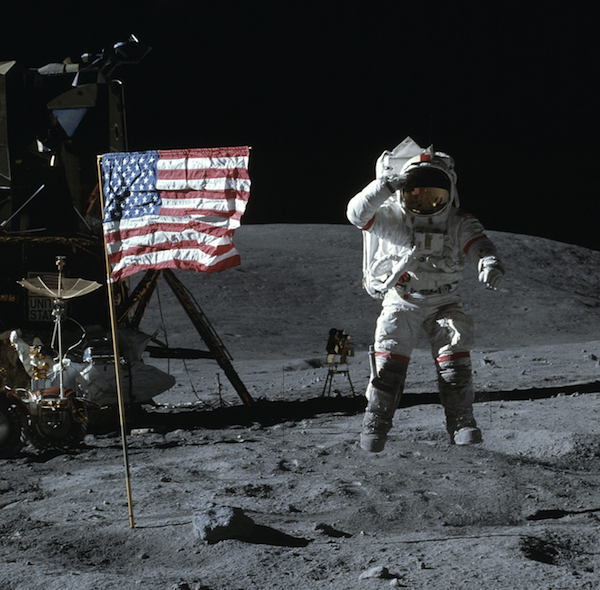
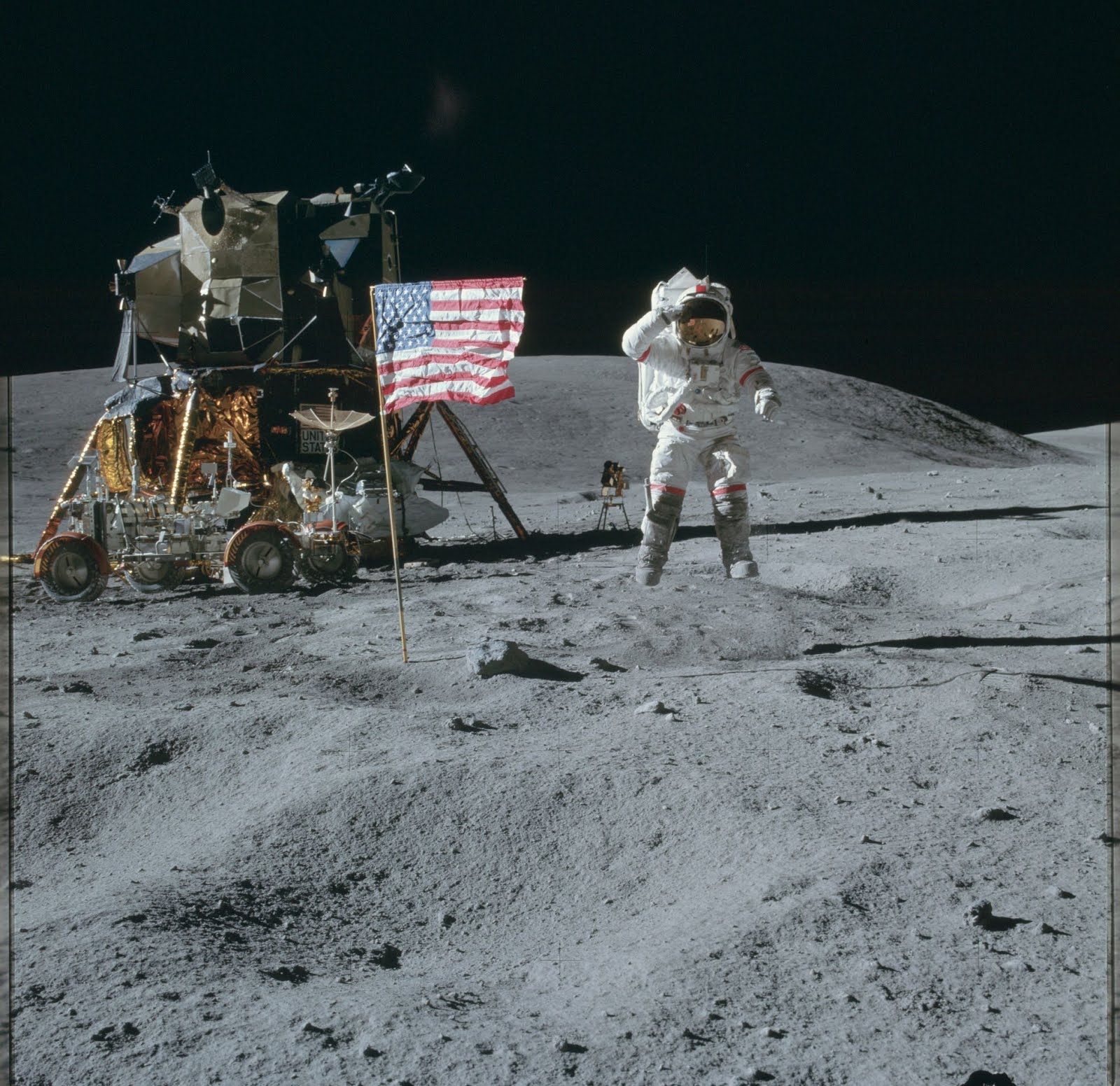
A patient search through the Apollo image archives reveals that it’s a cropped version of photo AS16-113-18339, taken during the Apollo 16 mission by Charlie Duke. It portrays his commander, John Young, as he salutes the flag.

Knowing the context in which the picture was taken provides the answer to the missing shadow. As noted in the mission reports and transcripts, and as recorded by the video footage of the mission, Young jumped vertically during the salute and Duke caught him in midair in the photograph. That’s why there’s no shadow at Young’s feet: the shadow is displaced downwards and to the viewer’s right, as occurs normally when someone is photographed during a vertical leap with a low sun angle.

An uncropped scan of the photograph (Figure 5.24-2) shows that the astronaut does indeed cast a shadow in the center right portion of the picture.

Figure 5.24-2. Detail of photo AS16-113-18339. John Young’s shadow is displaced towards the right because the picture was taken while he was jumping vertically.


John Young’s leap was seen by the TV camera mounted on the Rover and was televised live to Earth (Figure 5.24-3).

Figure 5.24-3. Live color TV of John Young’s jump on the Moon, from the documentary Nothing so Hidden.


5.23 How could the astronauts take so many photos in such a short time?

IN A NUTSHELL: By taking many of them in rapid bursts of 8-12 shots to form panoramic sequences; for example, almost half of the pictures of the Apollo 11 moonwalk were taken in this way, as the astronaut turned around on the spot. The same applies to the other missions.

THE DETAILS: Conspiracy theorist Jack White claims that the astronauts didn’t have enough time to take all the photographs that NASA says were taken on the Moon and also get some work done. Therefore, he argues on his website Aulis.com, some of the pictures must be fake.

White says that the Apollo missions, according to NASA’s reports, spent a total of 4,834 minutes on the Moon, taking 5,771 photographs. This is equivalent to an average of 1.19 photographs per minute (one photograph every 50 seconds) throughout the duration of all the moonwalks. White says that the Apollo 11 crew reached an even higher average, with one photo every 15 seconds (121 shots in 151 minutes).

The Apollo 11 figures given by White are almost correct: the film magazine used during mankind’s first moonwalk contains 123 photographs (not 121) taken outside the lunar module (catalog numbers AS11-40-5850 to 5970, plus AS11-40-5882A and 5966A), and Armstrong and Aldrin’s excursion lasted two hours and 31 minutes according to the Apollo Definitive Sourcebook.

Taking 123 photographs in 151 minutes, however, doesn’t yield an average of one picture every fifteen seconds. The actual average is less than one picture per minute. How does White get to 15 seconds? He introduces “arbitrarily” (as he puts it) a value of two hours to take into account the other activities of the astronauts:
Let’s arbitrarily calculate a MINIMUM time for these tasks and subtract from available photo time.

Why two hours and not two and a quarter, or one and a half? White doesn’t explain the reason for his choice. It’s obviously quite easy to get impossible results if you alter the data by introducing arbitrary values.

White also fails to specify that the astronauts took many sets of photographs from the same place, without wasting time getting into position and aiming again for each picture, so that the photos could be later assembled into panoramic views. In creating a panoramic sequence it’s quite easy to take a dozen photographs in a few seconds (try this yourself). This alters considerably the average time required. Here are a few examples.

Photos AS11-40-5881 to AS11-40-5891 (11 frames, almost 10% of all of the Apollo 11 moonwalk photographs) were shot by Buzz Aldrin as he turned around on the spot to form the panoramic view shown in Figure 5.23-1.

Figure 5.23-1. Panoramic view assembled by Dave Byrne for the Apollo Lunar Surface Journal with photos AS11-40-5881 to 5891.


Photographs AS11-40-5905 to AS11-40-5916 (12 frames, 10% of the total) compose another panoramic view, again taken by Aldrin and shown assembled in Figure 5.23-2.

Figure 5.23-2. Panoramic view assembled by David Byrne for the Apollo Lunar Surface Journal with photos AS11-40-5905 to 5916.


Frames AS11-40-5930 to AS11-40-5941 (12 shots) were taken by Neil Armstrong to form the panoramic view shown in Figure 5.23-3.

Figure 5.23-3. Panoramic view assembled by Brian McInall for the Apollo Lunar Surface Journal using photos AS11-40-5930 to 5941.


Figure 3.15 of NASA’s Apollo 11 Preliminary Science Report features a map which shows the location and direction of every photograph taken during the Apollo 11 excursion (Figure 5.23-4). The number of photographs taken in rapid sequence from the same location is quite considerable.


Figure 5.23-4. Map of the locations and directions of every photograph taken during the Apollo 11 moonwalk.


This map indicates that photographs 5850 to 5858 (9 shots) and 5954 to 5961 (8 shots) form two more panoramic views in addition to the ones shown above.

In summary, therefore, during the Apollo 11 moonwalk 52 photographs out of 123 belong to panoramic sequences that were taken in quick bursts, without moving and refocusing between shots.

The same applies to the other moonwalks, in which the astronauts took many panoramic sets (Figure 5.23-5 is an example from Apollo 16) and also took several stereo pairs, i.e., two photographs taken almost simultaneously from two slightly different viewpoints, which can be combined to produce 3D images.

Figure 5.23-5. Panoramic view assembled using photos AS16-113-18313 to 18330 by Lennie Waugh for the Apollo Lunar Surface Journal.


Once all the facts are on the table, it’s no longer surprising that the astronauts took so many photographs. What is surprising, instead, is that Jack White, who claims to have researched the Apollo missions thoroughly before making his allegations of fraud, has failed to consider this simple explanation, which is extensively documented and is self-evident from the photographs themselves.


5.22 How come the EVA photo of Michael Collins is fake?

IN A NUTSHELL: Because a conspiracy theorist altered the original to make it look fake.


THE DETAILS: According to Moon hoax theorist Ralph Rene, the autobiography of lunar astronaut Michael Collins, Carrying the Fire, contains a faked spacewalk photograph (Figure 5.22-1).


Figure 5.22-1. The allegedly faked photograph, as shown by Rene.


Rene claims that the autobiography describes this picture as Collins during a spacewalk in the Gemini 10 mission (1966), although it’s actually a photo taken during training inside an aircraft and then (says Rene) altered by NASA (Figure 5.22-2).


Figure 5.22-2. The other version of the photograph.


According to Rene’s book Nasa Mooned America!, these pictures “absolutely prove that NASA began to doctor photos three years before the Apollo missions allegedly landed men on the Moon”. Rene makes the same allegation in Willy Brunner and Gerhard Wisnewski’s documentary Die Akte Apollo, broadcast by German TV station WDR in 2002 and by Italian national network Rai in 2006.

Some basic fact-checking shows that the allegedly doctored version of the photograph does not appear in any NASA publication. It only appears in some editions of the Collins autobiography (the 1974 edition by Farrar, Straus & Giroux and the 1975 edition by Ballantine Books) and even there it is not described as being taken during the Gemini 10 spacewalk. The caption clearly states that it was taken during training in an aircraft.

Indeed, Collins himself notes with regret, in his book, that there are no photographs of his Gemini 10 spacewalk (“One of the great disappointments of the flight was that there were no photos of my spacewalk. [...] I was really feeling sorry for myself, unable to produce graphic documentation for my grandchildren of my brief sally as a human satellite”).

In 2003, space historian James Oberg offered Rene 10,000 dollars for any edition of the Collins autobiography that described the doctored photograph as a spacewalk snapshot. Rene was unable to provide one, and so far nobody else has either.

In their documentary, German authors Brunner and Wisnewski resort to misleading editing in order to support Rene’s allegation: first they show the cover of Carrying the Fire and then they crossfade to a page that contains the allegedly doctored photograph with the caption “Gemini 10 space walk”, as shown in Figure 5.22-3.


Figure 5.22-3. The Brunner and Wisnewski documentary Die Akte Apollo crossfades the cover of the Collins autobiography with a page from Rene’s book (stills from the Italian broadcast of the documentary, 2006).


However, this page is not taken from Carrying the Fire: it’s taken from Rene’s book Nasa Mooned America!, as revealed by the text on the page, which can be read in freeze-frame.

In summary, the entire allegation of fakery against Michael Collins and NASA is made up. Instead of demonstrating “absolutely” that the US space agency faked a photo, it demonstrates that some Moon hoax theorists are willing to stoop to falsehoods and editing tricks in order to prop up their claims.


5.21 How come NASA has published retouched photographs?

IN A NUTSHELL: Merely to repair scratches or blemishes in old scans of duplicates. The high-resolution master scans available through NASA show no such signs of fixing. Besides, if they had been retouched to hide something, it would mean that they were actually taken on the Moon; otherwise it would have been easier to reshoot them properly on the alleged movie set.


THE DETAILS: Perhaps surprisingly, it is quite true that some NASA websites have published badly touched-up versions of the Apollo images. For example, image S69-40308, posted for several years at Spaceflight.nasa.gov (Figure 5.21-1), is crudely retouched by cutting and pasting in its top right part (Figure 5.21-2). The alteration is revealed by the unusually repeating patterns in the lunar soil.


Figure 5.21-1. Image S69-40308, a frame from the Apollo 11 16 mm film, as shown at Spaceflight.nasa.gov in February 2010. Note the repeating patterns in the top right corner. Source: Archive.org.


Figure 5.21-2. Detail of the preceding image. The arrows indicate the duplicated regions.


Copy-pasting is often used in digital retouching to cover unwanted details or a flaw in the picture. Here the touch-up is so blatant that even dust specks that were on the scanned film have been conspicuously duplicated.

However, this doesn’t mean that NASA systematically retouches its pictures and is concealing embarrassing or top-secret details: it seems rather unlikely that a high-level cover-up would publish such clumsy and easily detectable fakes. Besides, NASA websites also offer other copies of this image that have not been retouched (for example at the Apollo Lunar Surface Journal). Further copies are available in private collections of vintage prints and don’t exhibit this retouching). These copies reveal that the copy-pasting is merely correcting defects in scans taken from old, damaged duplicates of the original films. It’s just a clean-up, not a deception.

It might seem unusual for NASA to publish such shoddy versions of the Apollo photographs, but contrary to the beliefs of many Moon hoax theorists the US space agency is not a wealthy, monolithic government body. It’s a big bureaucracy with many departments that often work in isolation from each other and with limited funds and equipment.

The end result is that various NASA departments each published on the Internet their own versions of the Apollo visual record, using the film copies that they had in their archives. In many cases those film copies were duplicates of duplicates made years or decades earlier, faded by time and damaged by handling.

Having no funds allocated for a fresh scan of the Apollo images, the departments used whatever they had, as Dave Williams of NASA Goddard Spaceflight Center told me in personal correspondence in September 2003. The same process generated the alleged letter C on a rock, debunked earlier in this chapter.

The unretouched, properly scanned originals are available from four main Internet reference sources: the Apollo Lunar Surface Journal, the Lunar and Planetary Institute, the Gateway to Astronaut Photography of Earth and the Apollo Archive. Details and Internet addresses are in the References section of this book.

Figure 5.21-3. A better scan of the same 16 mm frame, taken from Spaceflight.nasa.gov in 2018.


Actually, any claim that NASA is retouching photos to hide something leads to a contradiction of Moon hoax theories. If the photographs had been retouched beyond mere scratch or blemish correction, this would mean that they were actually taken on the Moon, otherwise it would have been easier to just go back to the set and take them again properly.