Showing posts with label C06 (VidFilmAnomalies). Show all posts

6.15 Is this video found footage from the movie set where the Moon landings were faked?

IN A NUTSHELL: No, it’s altered footage from the 1978 science fiction movie Capricorn One.


THE DETAILS: A black-and-white video published by the British Daily Star news website in 2018 is described as coming from the cutting room floor of the film editing department of the Texas State film production company, marked between 1966-1972” and was allegedly discovered in a shoe box in 2017”. According to the Daily Star, it shows film crews setting up cameras on a surface that looks identical to the white exterior of the moon.”

But anyone who is familiar with science fiction movie history will recognize this footage immediately: it’s from the production of the 1978 movie Capricorn One, which tells the story of a badly faked human mission to Mars.

Here is a comparison of frames from Capricorn One and from the Daily Star video. It becomes quite clear that the allegedly discovered footage has been turned to black-and-white to hide the reddish color of the fake Martian soil, which would have to be gray to fake the Moon.

Moreover, the light-colored background behind the Lunar Module makes no sense for faking the Moon, where the sky is black.

Figure 6.15-1. A frame of the Daily Star video shows stage lights, a light-colored background and two people in white clothes next to the descent stage of a Lunar Module.


Figure 6.15-2. Another frame from the video shows two people in white, one in black, the descent stage of a Lunar Module and a mockup of an Apollo Command Module.


Figure 6.15-3. A frame from Capricorn One (at 19:21) shows the same lights, the same people dressed in white and black, the same light-colored background and the same Command Module mockup. The black-and-white images are flipped with respect to this frame.


Figure 6.15-4. Another frame from the Daily Star video.


Figure 6.15-5. A frame from Capricorn One shows that Figure 6.15-4 is merely a cropped, blurred and black-and-white version of this scene of the movie. Even the studio lights match perfectly.


6.14 Why does the Moon look the same in two different places? Recycled Moon sets?

IN A NUTSHELL: Because they’re not two different places. A NASA documentary incorrectly edits two video clips of Apollo 16’s lunar excursion as if they were shot in different places on different days, but in the original raw footage the two clips are only seven minutes apart and belong to a long, unbroken sequence that occurs in a single location.


THE DETAILS: Bart Sibrel’s video The Rocks Cry Out: Apollo 16 Anomaly and the Fox TV show Did We Land on the Moon? accuse NASA of using the same location or movie set for two different sites of the Apollo 16 mission, which according to other NASA documents were located four kilometers (over 2.5 miles) apart and were visited on two different days (Figures 6.14-1 and 6.14-2).


Figure 6.14-1. A frame of the first clip disputed by Fox TV and Sibrel.


Figure 6.14-2. A frame from the second clip in dispute.


The first clip (Figure 6.14-1) shows a single astronaut and is captioned “Day One” by Fox, while the second one (Figure 6.14-2) features two astronauts and is labeled “Day Two”, but the location is unquestionably the same. Even the camera angle is identical.

According to the Fox show, “NASA claims the second location was two and a half miles away, but when one video was superimposed over the other, the locations appear identical.”

However, reviewing the full set of TV transmissions from Apollo 16 (as published for example by Spacecraft Films) reveals another story. In the original transmissions, the images in the two video clips are not referred to two separate days: they’re just seven minutes apart and belong to a single, unbroken sequence recorded during Apollo 16’s second day on the Moon, at 144 hours and 48 minutes and 144 hours and 55 minutes in mission elapsed time. They also refer to the same location. In other words, the accusations of fakery are bogus.

Moreover, the audio in the clips presented by Fox TV and Sibrel doesn't match the recordings of reference. For example, according to NASA's Technical Air-to-Ground Voice Transcripts the phrase “Well, I couldn’t pick a better spot” in the first clip actually comes from the first day of Apollo 16 on the Moon, at 123 hours and 58 minutes, and the words “That is the most beautiful sight” and “It’s absolutely unreal!” occur at 124 hours and 3 minutes and 144 hours and 16 minutes respectively.

The most likely source of this mismatch is a documentary commissioned by NASA to A-V Corporation in 1972 and rather ironically entitled “Nothing So Hidden...”, in which the clips have the same, incorrect audio presented by Sibrel and Fox TV and are shown as if they had been taken on different days.

In other words, Sibrel and Fox referenced a documentary instead of referring to the original footage, which is the only valid reference material. Their entire allegation is based on this fundamental error.

The alleged evidence of conspiracy is just an editing mistake in a documentary produced by a non-NASA company. Editing mistakes in documentaries are not evidence of NASA fakery; they’re merely evidence of inaccurate editing. Unfortunately, such mistakes or artistic licenses are frequent in supposedly faithful documentaries and often alter the understanding of an event. For example, as space historian James Oberg notes about Apollo 11,

A far more serious distortion appears in most — but not all — television documentaries of the mission. Since the “small step” was really so small and his body movement so subtle, the video of this event is not dramatic enough for some programs. Instead, the audio track of the first words is transferred forward about a minute to coincide with Armstrong’s first jump down the ladder to the footpad. This turns the poetic “small step” into an awkward big hop. That may satisfy action-oriented entertainment values but it is false history. It is untrue to the significance of Armstrong’s words.*


6.13 Why did Apollo 11 transmit color TV from space but not from the Moon?

IN A NUTSHELL: Different cameras, transmitters and antennas. Apollo 11’s Command Module had better and more powerful TV equipment than the Lunar Module. It could send a good color TV signal to Earth; the LM could not. Later missions carried improved cameras and equipment that allowed color TV from the Moon as well.


THE DETAILS: It may seem rather suspicious that Apollo 11 sent live color TV pictures during the trip (Figure 6.13-1) and even from lunar orbit but then switched to black and white for the all-important moonwalk.


Figure 6.13-1. Buzz Aldrin in the LM as the Apollo 11 spacecraft approaches the Moon, in a frame from the color TV transmissions sent using the Command Module camera and transmission equipment. Detail from NASA image S69-39532.


Indeed, Bart Sibrel, in A Funny Thing Happened on the Way to the Moon, notes this discrepancy and suggests that the perpetrators of the hoax decided it would be “better to open their debut mission with fuzzy pictures and numerous blackouts rather than show too much revealing detail of a false scene that was yet unproven”.

The actual reason for the switch was that the color transmissions were made using the Command Module’s TV camera and onboard transmission equipment, which was far more sophisticated (but unable to withstand the extreme temperature variations of a moonwalk) and powerful than the Lunar Module’s and also had a better, larger antenna.

The Command Module was powered by fuel cells, while the LM only had batteries, and this allowed the CM to spend more power on the TV signal.

Moreover, the transmission gear of Apollo 11’s LM lacked the bandwidth needed to send a color signal, while the CM had no such limitation. However, the CM could not be used as a relay because it orbited around the Moon every two hours and therefore was often out of contact with the LM or Earth or both.

Later missions used lunar modules equipped with more advanced and compact TV cameras and with greater power reserves, and deployed a large unfolding parabolic antenna (Figure 6.13-2) which allowed to transmit from the lunar surface with enough power to carry a color TV signal. Apollo 11 also had this antenna, but its deployment would have required twenty minutes out of the two hours available for the first moonwalk, so after NASA saw that the TV pictures from the Moon were good enough without this antenna they decided not to use it for this first mission.

Figure 6.13-2. An astronaut (probably Armstrong or Aldrin) during training to deploy the large parabolic lunar antenna after unfolding it. Photo AP11-S69-31179.


6.12 Why is there no exhaust from the LM’s ascent rocket engine?

IN A NUTSHELL: Because there shouldn’t be. Rocket motors don’t generate a fiery exhaust in the vacuum of space. Rockets that use the same propellant as the Lunar Module don’t generate a visible plume even in the Earth’s atmosphere. The same effect occurred with the Shuttle main engines and with Gemini Titan rockets, for example.


THE DETAILS: Bill Kaysing, in Fox TV’s Did We Land on the Moon? (2001), objects that “In the footage of the ascent stage going up, what you don’t see is an exhaust plume coming out of the rocket engine nozzle... What do we see? We see the ascent stage suddenly pop up without any exhaust plume whatsoever as though it were jerked up by a cable”.

Figure 6.12-1. Liftoff of the Apollo 17 Lunar Module on 14 December 1972, as shown by the live TV broadcast sent by the remote-controlled camera installed on the Rover.


It’s true that the liftoff footage doesn’t match the illustrations that NASA published in 1966, showing a very conspicuous plume under the Lunar Module’s ascent stage (Figure 6.12-2).

Figure 6.12-2. Artist’s illustration of the liftoff of the Lunar Module from the Moon, dated 1966. Source: NASA photo S66-5094, scanned by Mike Gentry and Jody Russell, NASA Johnson, ALSJ.


Actually, there’s no visible exhaust plume in the TV footage for a very simple reason: there shouldn’t be one. Rockets don’t usually produce persistent and extensive plumes in the vacuum of space. Artist’s illustrations are, indeed, art, and as such they take liberties in order to represent motion and explain what’s going on. If the drawing shown in Figure 6.12-2 didn’t show a plume, the general public for whom it was intended would have seen a spacecraft mysteriously floating above the Moon. Adding the plume is not scientifically accurate, but it’s a self-explanatory way to illustrate the fact that the spacecraft is being propelled by its rocket motor.

The lack of a plume in vacuum is documented for example in the footage from the Saturn V test flights, the authenticity of which is not disputed by conspiracy theorists (Figure 6.12-3).


Figure 6.12-3. Separation of the first stage of a Saturn V. The rocket engines of the second stage are ignited but don’t produce plumes.


Figure 6.12-4. Slow motion footage of the ignition of the S-IVB second stage of a Saturn 1B rocket during test mission AS-202, as viewed by an automatic film camera installed inside the top portion of the first stage. After a brief ignition blast, this rocket engine also doesn’t produce a visible plume in vacuum.


Recent space flights, such as SpaceX’s Falcon 9 booster missions, likewise have no plume once they’re out of the Earth’s atmosphere. This can be seen for example in Figure 6.12-5, which is a still from the 2018 launch of satellite Paz.

Figure 6.12-5. The motor of the second stage of SpaceX’s Falcon 9 rocket is firing, as shown by its red-hot nozzle, but it doesn’t produce a plume in the very thin air it encounters 393 km (244 miles) above the Earth. Source: SpaceX live broadcast.


Moreover, the Apollo LM used a mix of Aerozine 50 (50% hydrazine, 50% unsymmetrical dimethyl hydrazine) and dinitrogen tetroxide, which are hypergolic, i.e., they react spontaneously as soon as they come into mutual contact. This allowed a simple and highly reliable engine design. The product of the reaction of these substances is colorless and transparent: that’s another reason why there’s no visible plume under the LM as it takes off from the Moon.

The same type of propellant used in the LM was also used in the massive Titan launchers used in the Gemini manned spaceflight program (and also used as nuclear warhead delivery missiles), and their liftoffs produced a surprisingly small and colorless plume, with no flames, even in air (Figure 6.12-6).

Figure 6.12-6. Liftoff of a Titan rocket carrying the Gemini 12 spacecraft on November 11, 1966. Note the almost colorless engine exhaust and the lack of flames.


The Space Shuttle’s maneuvering thrusters also used hypergolic propellants and likewise produced no significant plume. Its three main engines also produced an almost colorless exhaust plume as they burned hydrogen and oxygen, whereas its solid-propellant side boosters generated a massive, fiery trail, as shown in Figures 6.12-7/8/9. 

Figure 6.12-7. The main engines of the Space Shuttle (left) have an almost colorless, transparent exhaust, while the solid-propellant boosters (right) produce a very conspicuous plume. Credit: NASA/Rusty Backer and Michael Gayle.


Figure 6.12-8. The Space Shuttle main engines at ignition (source: FSG).


Figure 6.12-9. Another view of the Shuttle main engines at ignition, showing the see-through exhaust (source: FSG).


Figure 6.12-10. The flameless liftoff of a British Black Arrow satellite launcher (1969-1971).


6.11 Does never-before-seen footage show astronauts faking the view of Earth from deep space?

IN A NUTSHELL: No. The footage has always been available and isn’t fake. Had it been shot from low Earth orbit through a circular window to make the Earth look small and distant, as some conspiracy theorists claim, it would show the clouds changing continuously as the spacecraft flies over different parts of the planet. They don’t.


THE DETAILS: Moon hoax theorist Bart Sibrel, in his video A Funny Thing Happened on the Way to the Moon (2001), shows an Apollo 11 video recording that he claims to be “never before seen or heard footage” in which the astronauts allegedly faked being far from Earth when they were actually still in low orbit around it.

According to Sibrel, they “placed the camera at the back of the spacecraft and centered the lens on a circular window in the foreground, outside of which it is completely filled with the Earth in low orbit. The circumference of the window then appears to be the diameter of the Earth at a distance, with the darkened walls of the spacecraft appearing to be the blackness of space around it.” (Figure 6.11-1).


Figure 6.11-1. A frame from the allegedly faked Apollo 11 video, as shown by Bart Sibrel.


In other words, according to Sibrel’s theory, the astronauts used the circular window to mask the bulk of the Earth and only show a circular portion of its surface, thus creating the illusion of a distant floating sphere.

In actual fact, the footage is not at all “never before seen or heard” as Sibrel alleges. It is part of a series of color TV transmissions made by the Apollo 11 astronauts on their way to the Moon, 10.5 hours and 34 hours after liftoff, when they were respectively 94,500 and 240,000 kilometers (51,000 and 130,000 nautical miles) from Earth. The full recording has been available for a long time, for example on the Apollo 11 DVDs published by Spacecraft Films.

Figure 6.11-2. The first of two live TV broadcasts made by Apollo 11 far from Earth matches Sibrel’s allegedly “never before seen” footage.


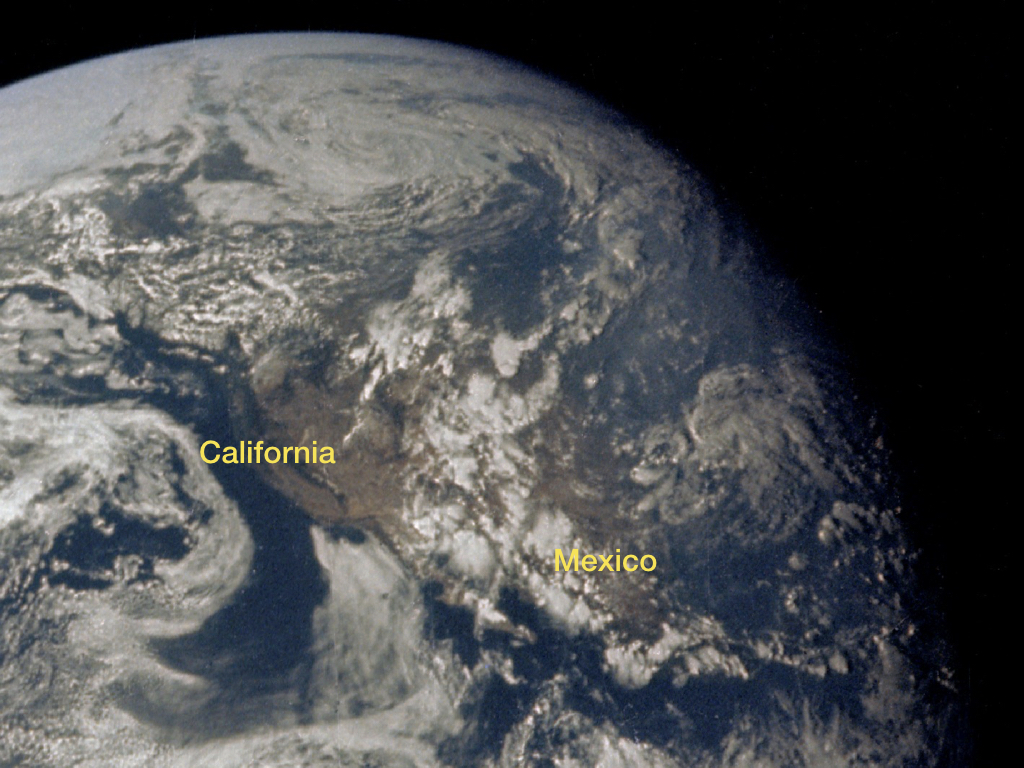
Sibrel’s version is recut out of sequence: the unedited footage simply shows the astronauts preparing for TV transmissions and testing the camera settings. This is evident by listening to their communications in full, as available in the Apollo Flight Journal (Day 1, part 4: Navigation and Housekeeping and Day 2, part 2: TV Transmission), instead of taking selected quotes out of context. These communications report that the pictures show the eastern Pacific Ocean, the west coast of North America and the southern coast of South America (north is down and to the left).

Moreover, the camera trick alleged by Sibrel wouldn’t have worked even if the astronauts had tried it. If the Apollo spacecraft had been in low orbit around the Earth, with its TV camera peeking through a circular mask at a small portion of the planet below, the footage would have shown ever-changing clouds and parts of the planet rolling by as the spacecraft rapidly circled the globe. The uncut, less grainy version of the video presented by Sibrel instead shows exactly the same unchanging cloud patterns for as much as fifteen minutes.

We can check what Earth would have looked like through a circular window in low Earth orbit by looking at the photographs taken from the International Space Station (ISS), at an altitude of 400 kilometers (248 miles). The difference is rather obvious.

Figure 6.11-3. Shannon Walker gazes at the Earth, specifically at the Caribbean region, through the circular window of the Cupola on the International Space Station. Source: NASA/Flickr.


Figure 6.11-4. Earth from the Cupola’s circular windows in a photograph taken by Scott Kelly. Fonte: NASA/Flickr.


Figure 6.11-5. Another view of Earth from the ISS, at an altitude of approximately 400 kilometers (280 miles). Source: ESA.


Figure 6.11-6. Earth clouds viewed from the Cupola. Source: NASA/SpaceRef.


Figure 6.11-7 instead shows what the Earth looks like from a distance of 1.5 million kilometers (930,000 miles). Once again, the difference is quite conspicuous.

Figure 6.11-7. Earth as seen by the EPIC camera of the DSCOVER space probe, located 1.5 million kilometers (930,000 miles) away from the planet, on 12 February 2018. Source: NASA.


This is confirmed by photograph AS11-36-5337, which was taken approximately at the same time as the TV transmissions and shows the same cloud patterns, allowing to determine that the TV picture disputed by Sibrel actually shows the entire North American continent and most of the Pacific Ocean (Figure 6.11-8). This would be impossible from low Earth orbit.

Figure 6.11-8. Comparison between Apollo 11 photo AS11-36-5337 and the Sibrel image (rotated so that north is up). North America is in the upper right portion.


Figure 6.11-9. Detail of photo AS11-36-5337, showing the North American continent.


6.10 How could NASA conveniently “lose” the tapes of the first Moon landing?

IN A NUTSHELL: They lost the raw tapes, but copies of all footage still exist. Specifically, NASA lost the direct TV recording of the first landing, which was made using a nonstandard format and was thought to be useless once converted to normal TV in the best possible way. The lower-quality converted recordings have not been lost. The lost tapes did not contain extra footage or different views.


THE DETAILS: As described in the technical primer at the beginning of this chapter, in the 1960s even achieving a fuzzy, black-and-white live broadcast from the Moon for the first landing required a substantial technological effort. Due to weight, power and other technical constraints, a non-standard miniaturized TV camera and a low-quality signal had to be used on the Moon, producing pictures that were less sharp than normal TV. These pictures had to be received on Earth and converted on the fly for worldwide live broadcast. This process caused considerable loss of quality.

The conversion was done in the only way available at the time: at the large radio telescopes that received the nonstandard TV signal directly from the Moon, a standard TV camera was pointed at the special monitors that were capable of displaying the pictures.

NASA recorded this converted television signal on standard videotape reels of the best quality available at the time. These tapes have not been lost (Figure 6.10-1).


Figure 6.10-1. One of the converted videotape reels of the Apollo 11 flight. Credit: DC Video.


The non-standard direct, unconverted signal from the Moon could not be recorded with ordinary video recording equipment, so NASA stored it on a track of the telemetry tapes of the flight.

However, this meant that these tapes were labeled as ordinary mission telemetry and were placed in storage with all the other technical records at the end of each mission. Several years after the end of the Apollo project, the stored telemetry was deemed of no further interest and its expensive tapes were sent to be wiped for reuse; this was standard practice at the time. The best-quality recordings of the Apollo 11 lunar excursion were thus deleted unintentionally.

These are the so-called “lost tapes”: they included no extra footage or different shots compared to the recordings that are currently available. However, they would have offered a far better view, in terms of detail and clarity, of that unique moment of history: we know because some of the engineers who worked at the receiving stations, such as Ed von Renouard and Bill Wood, took photographs and movies of the monitors that displayed the unconverted pictures (Figures 6.10-2 and 6.10-3). These unofficial recordings include the only existing footage (made by von Renouard on a Super 8 movie camera) of the jettison of the astronauts' backpacks after they reentered the Lunar Module.


Figure 6.10-2. Neil Armstrong in the live TV signal as broadcast from Houston (left) compared with the original signal received from the Moon at Goldstone (right, NASA image S69-42583) as recorded by taking a Polaroid photograph of the TV screen of the receiver on Earth. The black band is caused by the short exposure time of the camera and the slowly forming TV picture.


Figure 6.10-3. Armstrong and Aldrin at the foot of the Lunar Module ladder uncover the commemorative plaque on the spacecraft, as photographed in Houston from a standard TV monitor (left) and at the Parkes radio telescope, in Australia, from a monitor that displayed the direct, unconverted signal (right). Credit: Honeysucklecreek.net.


NASA’s handling of the original recordings seems unforgivably reckless and absurd today, but it should be noted that at the time it was widely believed that nothing better could be extracted from the master tapes. The digital image processing that we now take for granted was still in its infancy and the converted footage was considered good enough, especially compared to the quality of 1960s TV broadcasts, which was very low compared to today’s high-definition images.

In 2009, NASA published a detailed report (The Apollo 11 Telemetry Data Recordings: A Final Report) on the extensive international search for the missing master tapes and hired Lowry Digital, a film restoration company, to assemble, clean up and enhance the best available converted recordings with assistance from many of the engineers who had worked on the original transmission. The restored Apollo 11 moonwalk is now available online (Restored Apollo 11 Moonwalk Video).

Despite the restoration, the loss of the original recordings remains regrettable and is mitigated only partially by the faint hope that unofficial copies of the raw transmission might still surface from various sources.


6.9 How come Kubrick’s widow, Buzz Aldrin and others have confessed on film?

IN A NUTSHELL: Because the “confessions” are part of a 2002 French mockumentary, Opération Lune, which includes interviews with Buzz Aldrin, Henry Kissinger, Donald Rumsfeld, Christiane Kubrick and other authoritative figures, who openly say on camera that the Moon landings were faked. But in the final part of the mockumentary the interviewees reveal that the confessions are just an art prank.


THE DETAILS: A series of videos with astonishing confessions about the Moon landings made by former US Secretary of State Henry Kissinger, former US Secretary of Defense Rumsfeld and Christiane Kubrick (director Stanley Kubrick's widow) and Apollo 11 astronaut Buzz Aldrin, among others, is easily available on the Internet. These are not lookalikes and there is no lip-synching by voice impersonators: it’s actually them saying these things.

But it’s all part of a cleverly orchestrated prank, a mockumentary directed in 2002 by William Karel and broadcast by European TV network Arte as Opération Lune (also known as Dark Side of the Moon in English and as Kubrick, Nixon und der Mann im Mond in German).


Figure 6.9-1. The cover of the original French and English version of Opération Lune on DVD.


The German edition of Opération Lune is available as pay-per-view on Youtube (Figure 6.9-2).

Figure 6.9-2. The German edition of Opération Lune by William Karel.


Karel’s Dark Side of the Moon was originally a single, 52-minute fake documentary intended to test the gullibility of viewers and play with their sense of reality until the end, when the trick is revealed, but it soon found its way onto the Internet, where it was cut into shorter segments, which were presented out of context and often without including the explanation at the end. Accordingly, it is often cited as evidence by Moon hoax theorists, thus proving, albeit in an unintended way, Karel’s point about gullibility and the excessive authoritativeness we grant to celebrities.

The mockumentary actually contains several hints to its true nature: for example, if one listens carefully to what Aldrin, Kissinger and Rumsfeld say, it becomes evident that their words are being taken out of context; many of the historical events mentioned are blatantly wrong or false; and several of the names of the interviewees are lifted from famous movies, such as Jack Torrance (from Shining), David Bowman (from 2001: A Space Odyssey, Figure 6.9-3), Ambrose Chapel from Hitchcock’s The Man Who Knew Too Much, Eve Kendall and George Kaplan (both from North by Northwest).

Figure 6.9-3. A still from William Karel’s Opération Lune (Dark Side of the Moon) (Arte TV, 2002).


The end credits also include the outtakes and bloopers made by the famous people interviewed and turned into improvised actors by Karel, who ask the director whether they has been believable.

Even if the clips from the mockumentary are viewed without context, common sense should raise an obvious question: if the Moon landings were a crucial and secret fakery, why are these people talking about it and revealing it so openly and nonchalantly?

Some conspiracy theorists have an explanation for this, too: they assume that Opération Lune is actually a fake mockumentary intended to cover up the original fakery or prepare the general public for the eventual disclosure of the truth.*

* This claim, archived at Archive.is, is made for example by Massimo Mazzucco, creator of the American Moon conspiracy video.


The power to convince of this kind of documentary was demonstrated eloquently in June 2004, when a group of scientists was invited to see Opération Lune at the Pierre et Marie Curie University in Paris and discuss it with its director. Their reactions (Figure 6.9-4) when they discovered that they had been deceived by the director’s skill and by the power of images and of selective editing are an excellent example of the fact that culture and scientific knowledge in other fields are not necessarily sufficient to notice a cleverly executed con: this requires people who are expert in the specific field of spaceflight and of movie effects.

Figure 6.9-4. Full recording of the debate with scientists held at the Pierre et Marie Curie University and William Karel on 1 June 2004 (Operation Lune Debat avec William Karel, Réalisateur du Documentaire). Other copies are available: Conférence publique sur le documentaire Opération Lune avec son réalisateur; Débat avec William Karel autour de son film Opération Lune.


6.8 Is the “Moontruth” video an outtake from the fake TV broadcast?

IN A NUTSHELL: No, it’s a prank, specifically a viral video shot in 2002 by a British advertising company.


THE DETAILS: A video widely available on the Internet is often presented as a leaked outtake from the faking of the Apollo 11 moonwalk, showing Neil Armstrong as he climbs down the ladder of the Lunar Module and starts to say “That’s one small step for man, one giant leap for m...” until an overhead bank of studio lights comes crashing down and a film crew comes into view while a director’s voice yells “Cut!”.

Figure 6.8-1. The Moontruth video (The Viral Factory, 2002).


This video can be recognized by the Moontruth.com caption, but it’s not evidence that the Moon landing videos were faked and the outtakes were leaked: it’s actually an Internet prank created in 2002 by The Viral Factory, an advertising agency based in London, United Kingdom, to promote itself through word of mouth and create buzz (pun intended) about its work.

Today Moontruth.com is an empty shell, but in 2002 it was owned by the British ad company (as documented by a Whois ownership query conducted at the time) and it contained text that claimed that the video was an “Apollo 11 Moon Landing Footage Out-take.” However, easily revealed hidden pages explained the prank:

The clip is FAKED. It is not an out-take leaked from a NASA top secret reel. It was done in a studio, for fun, and to entertain webheads like us.

Yes, the clip is fake. It was shot in a studio in London in spring 2002. It was based on an idea by director Adam Stewart, who was a space exploration nut. He had read the conspiracy theory sites and decided he wanted to make a spoof based on the idea that the Apollo 11 moonlanding was faked. [...]

We shot on original 1960's Ikegami Tube Camera in Mount Pleasant Studios in London. The guy in the suit is an actor. The rest of the 'cast' were basically the crew, who thought the idea was very funny and wanted to be in it.

The landing craft and 'moonscape' were a set built by our art director, Richard Selway. The ladder that 'Neil' descends was made according to original blueprints that were downloaded off the Net. The rest of the set was built to match the original as closely as possible.

The moon surface was cement dust. It was disgusting. Even with the studio ventilation on full it got everywhere, and at one point there was so much of it floating round, the lights were flaring really badly.

The footage was treated in post-production to give 'Neil' his weightlessness and the ghosting effect of the original. We re-recorded and processed the soundtrack to recreate the effect of sound traveling all the way from the moon.

We think it's pretty convincing, and one thing's for damn sure – it was a lot cheaper than really going to the moon.


Figure 6.8-2. The explanation of the Moontruth video (2002), preserved at Archive.org.


This explanation is currently preserved at Archive.org and the true origins of this video are recorded in detail by the well-known Snopes.com hoax debunking site. A few videos showing the production of the clip are still available online (Figure 6.8-3).


Figure 6.8-3. Behind-the-scenes footage from Moontruth (2002).


6.7 Why did the astronauts only make such low jumps?

IN A NUTSHELL: They might look low until you consider that the astronauts were wearing a suit and backpack that doubled their weight and had very limited flexibility, and that a fall on the airless Moon could have killed them.


THE DETAILS: One of the best-known lunar jumps is the one performed by John Young as he saluted the American flag during one of the Apollo 16 moonwalks. Figure 6.7-1 shows the video recording of this event, which was also photographed by Charlie Duke (Figure 6.7-2).

Figure 6.7-1. Video recording of John Young’s lunar jump during Apollo 16. The other astronaut, on the right, is Charlie Duke.


Figure 6.7-2. John Young’s lunar jump, photographed by Charlie Duke (AS16-113-18339).


Moon hoax proponents say that Young’s hop is strangely short and so are all the other lunar jumps. They argue that on the Moon, with one-sixth of Earth’s gravity, astronauts should be able to perform amazing leaps, maybe six times as high as on Earth. Perhaps the hidden wires couldn’t lift them high enough or fast enough?

Actually, there are very practical reasons for these short hops.

  • First of all, every lunar astronaut was wearing a spacesuit and a backpack that weighed, on Earth, about 80 kilograms (176 pounds): as much as the astronaut himself. Although on the Moon this gear weighs one sixth of its Earth weight, i.e., about 13 kilograms (28 pounds), it is still a substantial extra ballast that the astronaut has to lift in order to jump.
  • In space and on the Moon it is necessary to distinguish between weight and mass: weight decreases in a low-gravity or zero-gravity environment, but mass remains unchanged and therefore inertia is the same as on Earth. Therefore the leaping astronaut had to overcome the inertia of his 80-kg (176-lb) gear and of his own body just like on Earth.
  • John Young performed a standing jump, with no run-up, as shown in the video of Figure 6.7-1, and this limited the energy that he could put into the jump.
  • Young was wearing a very bulky and stiff suit, limiting his freedom of motion and therefore again the energy he could put into his leap by bending his legs and moving his arms (Figure 6.7-3).
  • More importantly, the astronaut was on the Moon, surrounded by a deadly vacuum. He was well aware that if he fell and cracked his helmet, damaged the backpack that supplied him with air and cooling or tore his pressurized inner suit, he would die by decompression or suffocation. In such conditions, it was rather wise not to try and set high-jump records.

Figure 6.7-3. John Young just before his allegedly controversial standing jump. Note the very limited bending of his legs.


Many hoax theorists also make the mistake of considering Young's jump as the highest ever made on the Moon. Actually, it was just a hop intended to take an unusual salute photograph. Other jumps were much higher and correspondingly more dangerous.

For example, Neil Armstrong reported that he jumped up to the third rung of Apollo 11's LM ladder, which was “easily five or six feet [150-180 centimeters] above the ground”*. His leaps are visible in the recordings of the TV transmission of his moonwalk (Figure 6.7-4).

* Apollo 11 Technical Crew Debriefing, 31 July 1969, in NASA Mission Reports - Apollo 11, Vol. 2, Apogee Books, p. 89 (page 10-61 in the original numbering).


Figure 6.7-4. Neil Armstrong’s leap to climb back into the LM at the end of the Apollo 11 moonwalk, in the restored footage of the live TV transmission (to the right of the flag, in the shadow of the LM, at 2:16:40).


However, Armstrong refrained from further experimentation, because he noted that “there was a tendency to tip over backward on a high jump. One time I came close to falling and decided that was enough of that.”* A backward fall would in fact have entailed the risk of seriously damaging the suit backpack, forcing to cut short the moonwalk.

* Apollo 11 Technical Crew Debriefing, 31 July 1969, in NASA Mission Reports - Apollo 11, Vol. 2, Apogee Books, p. 76 (page 10-28 in the original numbering).


Young himself and his crewmate Charlie Duke engaged in a televised high-jump contest at the end Apollo 16's third moonwalk. Duke estimated that Young had jumped “about four feet [120 centimeters] (Figure 6.7-5); Duke made an equally high jump, but fell backwards onto his backpack.

In his book Moonwalker, he reported that it was “the only time in our whole lunar stay that I had a real moment of panic and thought I had killed myself. The suit and backpack weren’t designed to support a four-foot fall. Had the backpack broken or the suit split open, I would have lost my air. A rapid decompression, or as one friend calls it, a high-altitude hiss-out, and I would have been dead instantly. Fortunately, everything held together.”*

* Moonwalker by Charlie and Dotty Duke, p. 206.


Figure 6.7-5. Young and Duke do high-jumps on the Moon and Duke falls.


6.6 Does video show the astronauts’ wires catching the light?

IN A NUTSHELL: No. It shows reflections off the spacesuits’ radio antennas, which take on unusual colors due to the process used to generate the color TV picture. Besides, why would NASA use shiny wires instead of black ones?


THE DETAILS: The momentary glow that appears above the heads of the astronauts in some TV pictures isn’t a studio light reflected by the hypothetical wires used to simulate low lunar gravity. It's usually a reflection off the radio antenna located at the top of the astronauts' backpack.

This antenna was flat and shiny (Figure 6.6-1), so it was hard to see it when its edges faced the camera but it became suddenly visible, reflecting the sunlight, when the astronaut turned (Figures 6.6-2 and 6.6-3).


Figure 6.6-1. Detail of the flat VHF antenna stored on the backpack of astronaut Charlie Duke’s suit (Apollo 16). Credit: K.C. Groneman and D.B. Eppler, NASA Johnson.


Figure 6.6-2. A strange colored glow above an astronaut’s head.


Figure 6.6-3. Another colored glint above the head of an astronaut.


This glow appears just above the suit backpack (PLSS), exactly where the antenna was located.

This glow is often brightly colored for a very unusual reason, which can be understood only with the aid of in-depth knowledge of the technology used for the live TV transmissions from the Moon.

The color TV camera used on the Moon actually had a black-and-white sensor with a color wheel (Figure 6.6-4) in front of it. The colored filters on this wheel rotated rapidly in front of the camera's sensor so as to generate a sequence of monochrome images filtered in red, green and yellow. These filtered images were then blended and processed electronically on Earth to reconstitute the original colors of the scene.

This system was sturdy and lightweight, but it had the drawback that if an object flashed rapidly in front of the camera it was caught by only one of the colored filters, acquiring a false coloring in the electronic processing.


Figure 6.6-4. The rotating color filters of a lunar TV camera.


In other instances, the apparent reflection of light on wires is a compression artifact: a false image detail generated by repeated conversion and compression of a video, for example for posting on the Internet. This sort of effect occurs in any digital video or photograph that is compressed and converted several times.

The original video footage of the lunar missions, which is the only valid reference for proper research, doesn’t have these artifacts.

Besides, why would the perpetrators of the alleged fakery use shiny, reflective wires, when the wires commonly used in movie effects are nonreflective and black?

Figure 6.6-5. Nonreflective wires used in The Matrix (1999).


6.5 Were the astronauts lifted by wires when they fell?

IN A NUTSHELL: No. Their movements on the Moon seem odd because they weighed less than 30 kilograms (66 pounds) including their suit, and their spacesuit and backpack displaced their center of gravity considerably upwards and backwards. Also, they used the spring-like elasticity of the suit to get back up, as practiced in training.


THE DETAILS: The way the astronauts regained their footing after a fall on the Moon appears unusual and too easy to non-expert viewers. But on the Moon the Apollo astronauts weighed one sixth of their Earth weight due to the lower lunar gravity, which is indeed one sixth of the Earth’s. Their backpack and spacesuit weighed a total of approximately 81 kilograms (180 pounds) on Earth, which became a mere 13.5 kilograms (30 pounds) on the Moon. Their body weight was likewise reduced: an 80-kilogram (178-pound) person on the Moon weighs 13.3 kilograms (29.3 pounds).

In other words, on the Moon a fully suited astronaut weighed a total of about 30 kilograms (66 pounds). Getting up after a fall, therefore, was trivial in terms of effort. Doing it without toppling over again, however, was challenging.

The way the astronauts got back on their feet looks unusual because in addition to being in one-sixth gravity they were carrying a backpack (known as PLSS) which was quite heavy in proportion to their body weight (more precisely, its mass was considerable if compared to the mass of their body). Their PLSS weighed 26 kilograms (57 pounds) on Earth and 4.3 kilograms (9.5 pounds) on the Moon – one third of their body weight – and therefore displaced their center of gravity upwards and backwards. That’s why they were always leaning forwards: to compensate for the heavy load on their backs.

The video shown in Figure 6.5-1 is often referenced by conspiracy theorists as an example of these unusual maneuvers:

Figure 6.5-1. Astronaut Charlie Duke picks himself up by pushing with this arms after falling forwards on the Moon at 144:35.24 mission elapsed time. Source: Apollo 16 Video Library at Nasa.gov.


However, Charlie Duke, the Apollo 16 astronaut featured in this video, has explained in his many public talks that the footage actually shows a practical application of the special method that had been devised during simulations on Earth to take advantage of the elastic resistance of the spacesuit to get back up after a fall. During parabolic flights in aircraft which simulated lunar gravity, Duke had found out that two or three “push-ups” were needed to spring back to an upright posture by rotating about his center of gravity.

Moreover, the wire theory fails because the Apollo TV footage includes unbroken sequences that last tens of minutes, during which the astronauts change direction and position repeatedly. How would the wires not get tangled up?

There's also the problem that the TV coverage includes many wide shots, which would require extremely long wires to keep the control rig and winch out of frame.


6.4 Who stayed behind to shoot the liftoff from the Moon?

IN A NUTSHELL: Nobody. The footage of the liftoff of the Lunar Module from the Moon was shot using an independently powered TV camera that was radio controlled from Earth.


THE DETAILS: The visual record of the Apollo missions includes footage of the liftoff of the Lunar Module from the Moon. Some conspiracy theorists and doubters argue that this video must be fake, since there was nobody left on the Moon to take the pictures and even move the camera to follow the ascent stage of the Lunar Module as it climbed into the sky.

Figure 6.4-1. The live color TV footage of Apollo 17’s liftoff from the Moon: the ascent stage of the Lunar Module separates from the descent stage and its rocket motor exhaust propels fragments of the thermal protection of the descent stage.


The answer is simple, if you take the time to read the technical documents of the Apollo missions: the lunar liftoff was shot only during Apollo 15, 16 and 17, when the TV camera was installed on the Rover (the astronauts' electric car), which at the end of the excursion was parked approximately 90 meters (300 feet) east of the Lunar Module for the very purpose of recording the liftoff of the LM.

The camera equipment was powered by the batteries of the Rover and was controlled remotely by an operator on Earth through a radio link. Indeed, its technical name was GCTA, which stands for Ground Controlled Television Assembly.


Figure 6.4-2. Graphic reconstruction of how the LM liftoff videos were shot. From the documentary Live from the Moon (Spacecraft Films).


The signal from the TV camera left on the Moon was transmitted directly to Earth through the parabolic antenna installed on the Rover, using the same method used to transmit the astronauts' moonwalks. At the time, video recording equipment was very bulky and heavy and therefore the lunar camera was not equipped to record. The liftoff had to be relayed to Earth live. Moreover, the shot had to be carefully planned beforehand.

The radio control signals in fact took about two seconds to travel from the control center in Houston to the transmitters located at various sites on Earth and from there to the Moon at the speed of light. This two-second delay made it impossible to correct the camera movements in real time: any command would reach the camera too late. Accordingly, NASA had to calculate in advance a very precise placement of the TV camera and send all commands two seconds earlier in order to have the camera tilt up and follow the ascending lunar module at the right time.

For the Apollo 15 liftoff, the camera did not tilt to follow the spacecraft, due to a malfunction of one of its motors. For Apollo 16, the camera operator, Ed Fendell, tried to follow the ascent, but was unable to do so because the Rover had not been placed correctly by the astronauts at the exact preplanned distance required to achieve the shot.

The Apollo 17 liftoff shot was achieved almost perfectly and managed to keep the spacecraft in frame as it departed.

Figure 6.4-3. Ed Fendell, the remote-controlled TV camera operator, explains the details of how the liftoff shots were achieved.


Incidentally, since the entire system was powered independently by batteries, it was able to transmit even after the astronauts had left the Moon, sending back lonely images of the moonscape, once again devoid of life and motion after humankind's brief visit.


6.3 Who was already outside to televise Armstrong’s first steps?

IN A NUTSHELL: Nobody. There was an automatic TV camera attached to the outside of the lunar module.


THE DETAILS: Some doubters ask how the TV footage of Neil Armstrong’s first steps on the Moon was shot from ground level outside the spacecraft if nobody was on the Moon yet to hold the camera.

The answer can be found in the technical documentation of the Apollo missions, which shows that the TV camera was located on the outside of the lunar module. The wide-angle lens of the camera gives the impression that the viewpoint was far away, but the camera was actually quite close to the descent ladder.

One of the sides of the octagonal structure of the lunar module descent stage supported a tilt-down container known as Modular Equipment Storage Assembly or MESA (Figure 6.3-1), which was used to store the various instruments and tools that the astronauts would use during their moonwalks. This container also supported the TV camera (Figure 6.3-2), which was mounted on a bracket and was already connected to the power supply and to the onboard transmission equipment. The placement of the camera had been preplanned and rehearsed for the very purpose of documenting this historic moment. No external TV operator was required.

Figure 6.3-1. A training mock-up of the Lunar Module shows the tilt-down MESA container in the deployed position, to the left of the ladder. The arrow indicates the TV camera, which is in the position for broadcasting the descent along the ladder.


Figure 6.3-2. Apollo 11's lunar TV camera, upside down on its bracket inside the MESA.


During the Apollo 11 mission, Neil Armstrong, the first astronaut to exit from the LM, pulled a cable while he was still at the top of the ladder. This cable released this container and allowed it to open by tilting downward. This automatically positioned the black-and-white TV camera. Its supporting bracket was not perfectly horizontal: that’s why the TV picture of Armstrong’s first steps is tilted (Figure 6.3-3).

Figure 6.3-3. A TV picture of Neil Armstrong on the Moon during Apollo 11, straightened to correct the tilt of the camera mounted on the outside of the lunar module. Photograph taken by Ed von Renouard by pointing a film camera directly at the monitor that displayed the images from the Moon at Honeysuckle Creek, in Australia.


The same camera was then removed from its receptacle, installed on a tripod and placed at a certain distance from the LM, to which it was connected by means of a cable, so as to televise the entire Apollo 11 moonwalk.

A similar solution was used for Apollo 12; however, the TV camera (a color version this time) was pointed at the Sun by mistake shortly after the beginning of the first moonwalk (at 51:30 in Figure 6.3-4). The intense sunlight damaged its sensor, putting an abrupt end to live television from the Moon for the remainder of that mission.

Figure 6.3-4. The TV broadcast of the Apollo 12 moonwalk.


The camera was installed upside down in its MESA receptacle and therefore the pictures of the astronauts’ descents along the ladder were transmitted from the Moon upside down. Technicians on Earth would flip the image to broadcast it right way up, but at the very beginning of the Apollo 11 lunar TV transmission they momentarily forgot this task and so the first seconds of the broadcast are upside down.

A similar mishap occurred during Apollo 12: the TV signal was flipped correctly to show Pete Conrad’s descent, but when he turned the camera right way up to mount it on the tripod (at 37:00 in Figure 6.3-4) the image remained flipped and therefore showed Alan Bean’s descent upside down.


6.2 Why does the flag flutter on the airless Moon?

IN A NUTSHELL: It's not fluttering: it's swinging, and it only does so when the astronauts handle it or touch it, or when it is struck by the blast of the lunar module’s maneuvering rockets or by the air vented from the hatch. Moreover, the way it swings is different from how a flag swings on Earth and actually proves that the footage had to be shot in a vacuum.


THE DETAILS: In the TV and film footage of the lunar landings, the American flag sometimes moves as if it had been blown by a sudden gust of air. That, it is argued, is impossible on the airless Moon; therefore, according to conspiracy theorists, this proves that the moonwalk footage was faked in a movie studio.

One might ask why the movie set used for the most important and complex fakery of the twentieth century would be so ridiculously shoddy as to have drafts, or why the people in charge of the hoax would be so pathetically dumb as to leave such glaring and revealing mistakes in the final product, but never mind. There's a simple and rather interesting explanation for the apparently strange behavior of the flag.

If you examine the Apollo footage, you find that when the flag “flutters” it continues to oscillate stiffly and unnaturally for quite a while, differently from a flag on Earth, which changes shape and comes to a standstill almost immediately. This unusual and persistent oscillation is possible because the flag is moving in an airless environment, without encountering any air resistance. If you compare the Apollo videos with footage of a flag moving on Earth, the difference in behavior is very obvious.

In 2008 the TV show Mythbusters put this to the test. An accurate replica of an Apollo flag was placed in a large vacuum chamber and its pole was turned, just like the astronauts did on the Moon. The same turning motion was applied while the chamber was filled with air and after the air had been extracted to produce a vacuum. The difference was quite evident: when the flag was in vacuum, it swung for much longer and in the drag-free way seen in the Apollo television record.

Figure 6.2-1. A flag is swung in a vacuum for Mythbusters (2008).


In other words, the anomalous motion of the lunar flags doesn't confirm the hoax theories: on the contrary, it confirms that the footage of the moonwalks was shot in a vacuum.

Careful examination of the lunar footage, cross-checking it with mission timelines, also shows that the flag “waves” only in very specific circumstances.

For example, the flag moves when an astronaut turns its pole to drive it into the ground (Figure 6.2-2). After the flag has been erected and left to settle, it doesn't move. Even its creases and wrinkles remain unchanged throughout the excursion, as discussed in Section 5.3 for the Apollo 11 flag.

Figure 6.2-2. Flag oscillation in an Apollo TV transmission while an astronaut drives its pole into the soil.


The Apollo 14 “flutter”


In the video footage of Apollo 14, the flag oscillates repeatedly, entering the frame and exiting it, without being touched by anyone. At this point in the mission timeline, the astronauts are inside the lunar module.

Figure 6.2-3. Flag oscillations in the video Moon Hoax Now 2017: Apollo 14 - Hidden Flag (2017).


The technical explanation suggested for this slight motion is the gradual venting of the lunar module cabin air. The flutter in fact occurs while the astronauts are getting ready for their second moonwalk and this means that they have to vent all the air inside the cabin. This venting occurred through a valve located on the lunar module hatch, which faces the flag.

Such venting of a large volume of air into a vacuum, therefore without the pressure and resistance of an atmosphere, would create a swiftly expanding cloud of air, which would strike the flag gently but with enough force to make it swing, especially since the flag is not hindered by air resistance. It would have a nonzero pressure on one side and zero pressure on the opposite side, so some motion would be inevitable.


The Apollo 15 “flutter”


There’s a moment in the Apollo 15 footage, at 148:57:15 in mission elapsed time, in which the flag swings stiffly, with the typical oscillation that occurs in a vacuum, although apparently it has not been touched by astronaut Dave Scott as he passes in front of it (Figure 6.2-4).

Figure 6.2-4. Flag oscillations (at 2:36) in the video Apollo 15 flag waving (2007).


At first glance, it does indeed look as if Scott’s movement displaced some air which impinged on the flag. But before arguing that this is unquestionable evidence of fakery, other non-conspiratorial explanations should be considered. Experts have been intrigued by this phenomenon and have discussed it at length in the Apollo Lunar Surface Journal (EVA-2 Closeout, at 148:57:15).

For example, the apparently mysterious motion may have been due to actual contact between Scott’s left arm and the flag. Due to the wide-angle setting of the camera lens, which exaggerates depth, Scott appears to be farther away from the flag than he actually is. This would explain the fact that only the lower portion of the flag moves (Figure 6.2-5).

Figure 6.2-5. Discussion of the Apollo 15 flag motion from the video Apollo 15 moving flag analysis (2010).


Another possible explanation is an electrostatic effect. As Scott walked on the lunar surface (which has a significant electrical charge of its own due to the ionizing effect of ultraviolet radiation and particles from the Sun), he may have accumulated a charge which attracted or repelled the flag in the same way that a plastic rod rubbed on a wool sweater attracts or repels hair or pieces of paper.

Since the almost-perfect vacuum close to the lunar surface is highly dielectric (i.e., essentially incapable of conducting electric currents), charge accumulation is easier than on Earth. Moreover, any attraction or repulsion of the flag is more conspicuous on the Moon than on Earth because on the Moon there's no air to slow the flag.

Another conceivable scenario is that the discharge from the astronaut's backpack sublimator might have created a momentary puff of gas that impinged on the flag. This would explain the fact that only the bottom corner of the flag moves.

Whatever the actual cause is, it can’t be an air displacement on a movie set, because the same video sequence shows that the dust kicked by the astronaut’s boots doesn’t swirl, but falls sharply and neatly in an arc. This is typical of a vacuum and is not possible in air. The flag’s slow and long-lasting oscillation is also consistent with a low-gravity vacuum environment.


6.1 Apollo video and movie technology: a quick primer

The Apollo visual record includes both video recordings, made using TV cameras that transmitted their pictures to Earth, where they were rebroadcast and recorded on magnetic tape, and film footage, shot using movie cameras that recorded the pictures onboard on 16 mm film.

Today it’s quite commonplace to use the term video for any kind of moving picture, lumping together TV and film, but in the Sixties there was a huge quality and portability gap between television and movie technology.

The miniaturization afforded by modern electronics was in its infancy. Studio TV cameras for color broadcasts were bulky, inefficient, power-hungry monsters that weighed over 125 kilograms (280 pounds), like the ones shown in Figure 6.1-1.


Figure 6.1-1. RCA TK-43 color TV cameras in the 1960s. Credit: Oldradio.com.


Early “portable” color TV cameras, such as the Ikegami HL-33, made their debut only in the Seventies. Black-and-white models were slightly less unwieldy, but they were still massive, power-hungry, heavy devices that could not be used in low light and depended on an external electric power supply and on even bulkier recording equipment. Moreover, they provided rather poor picture quality: nothing even comparable to today’s tiny high-definition video cameras and recorders that we carry in our pockets as part of our cellphones.

Movie cameras, instead, were already a mature technology. They were compact, lightweight, sturdy and fully independent of mains power thanks to batteries or wind-up mechanisms. Movie cameras for amateur use were just a little bit bigger than a still camera.

For example, a professional Arriflex movie camera using 16 mm film weighed about six kilograms (13 pounds) and required no extra equipment, apart from an optional sound recorder and a good supply of film, to shoot anywhere in the world, taking moving color pictures with a quality that far surpassed that of television. A professional movie camera was, in a way, the 1960s equivalent of today’s portable high-definition video gear.

Movie cameras were used for virtually all news footage, for war zone reporting and for detailing science experiments, missile launches and aircraft tests, thanks also to the in-depth analysis offered by slow motion, which was easy to achieve with film but technically unattainable with the TV cameras of the day (the film was simply fed through the camera at a faster rate and then shown at the normal rate).

The key drawbacks of movie cameras were of course the recording time, which was limited by the amount of film available, and the impossibility of live broadcasts, since film had to be developed by a chemical process. But if live transmission was not indispensable and a deferred viewing was acceptable, in the Sixties film was king. It’s important to bear this in mind in order to understand the technical choices made by NASA in documenting the Apollo flights.


The Apollo movie cameras

The Apollo lunar missions carried so-called Data Acquisition Cameras (DAC), movie cameras that used 16 mm color film magazines (Figure 6.1-2).


Figure 6.1-2. The Maurer 16 mm movie camera used in the command module of Apollo 11. Credit: Smithsonian National Air and Space Museum.


They were extremely compact and lightweight: including the side-mounted magazine, they measured approximately 22 x 13 x 6.5 centimeters (8 3/4 x 5 x 2 1/2 inches) and weighed 1300 grams (2.9 pounds).

One of these movie cameras was mounted in the Lunar Module so as to look downward out the right side window of the spacecraft, as shown in photograph AS11-36-5389 (Figure 6.1-3). This simple but effective technology is what gave us color pictures of the lunar module's descent to the Moon and of Neil Armstrong's first footstep on the lunar surface.


Figure 6.1-3. The Maurer movie camera in position before Apollo 11's Moon landing. Detail from photo AS11-36-5389.


Most of mankind's first moonwalk (86 minutes out of 131) was filmed in color with this system. The first few minutes used a rate of 12 frames per second, half that of a normal movie; the remainder of the excursion was shot at one frame per second in order to save film, since each film magazine only contained 39.6 meters (130 feet) of color film, which at a normal frame rate (24 frames per second) would have been enough to shoot a little more than three and a half minutes. Reducing the frame rate increases the recording time but produces jerkier moving pictures. At one frame per second, the film footage is more like a series of still photographs than an actual moving picture record.


In later missions, after Apollo 11, the movie camera was taken outside, on the lunar surface. For Apollo 12 it was placed on the Lunar Hand Tool Carrier (a frame with legs); on Apollo 14 it was installed on the Modularized Equipment Transporter, a sort of wheeled cart; for Apollo 15, 16 and 17 it was mounted on the Lunar Rover (Figure 6.1-4, which shows how truly small the camera was).


Figure 6.1-4. Top left: the movie camera mounted on the Rover, next to Charlie Duke, during training for Apollo 16.


All this footage is now available at medium resolution on the Internet and in high resolution on the DVDs and Blu-rays published by specialist firms such as SpacecraftFilms.com.


The Apollo TV cameras

Transmitting television pictures from space and from the Moon entailed two technological challenges that had never been met before.

The first one was to build a TV camera that could work in a vacuum, withstand great brightness and temperature variations between shadow and sunlight and survive the intense vibration and acceleration of liftoff, yet be compact and lightweight enough to allow an astronaut to carry it and operate it in the confined space of the interior of a spacecraft and on the lunar surface.

The other challenge was to find a way to send back to Earth a live television signal from a distance of almost 400,000 kilometers (250,000 miles) using only the electric power available on board the Apollo craft and the vehicle's radio transmission equipment, which had been designed for entirely different purposes. Live TV from the Moon was, in a way, an afterthought.

Apollo 7 and Apollo 8 carried a single black-and-white slow-scan TV camera made by RCA. With Apollo 9, NASA tested and used a black-and-white TV camera built by Westinghouse intended for later use on the Moon. Apollo 10 introduced a Westinghouse color TV camera, qualified only for inflight use. Apollo 11 carried a color camera for onboard use and a black-and-white camera for use on the Moon.

The Westinghouse Lunar Camera used on Apollo 11 (shown on the left in Figure 6.1-5) used only 6.5 watts, measured 28 x 15 x 7.6 centimeters (11 by 6 x 3 inches) and weighed 3.3 kilograms (7.25 pounds), yet was capable of working in the harsh environment of the Moon, with its vacuum and its temperature extremes. This remarkable performance, miniaturization and weight reduction were achieved by using 43 integrated circuits, which were very rare in those days, and a special component, an SEC (Secondary Electron Conduction) tube, which at the time was a military secret.

Figure 6.1-5. Stan Lebar, head of Westinghouse's Apollo TV camera project,
shows the onboard camera (left) and the lunar camera (right) for Apollo 11.


This achievement, however, came initially at the cost of color. That's why the TV pictures of the first Moon landing are in black and white.

As technology progressed and NASA's confidence in being able to receive a complex TV signal from the Moon improved, subsequent missions were provided with a slightly larger color lunar camera, which produced color by using the same clever method used by the onboard camera: a color wheel (a disk with colored filters) spun in front of the monochrome camera sensor, generating a set of three color-filtered pictures, which were reassembled by the ground stations on Earth to recreate the original colors. This was a very compact and reliable system, although it caused multicolor halos around rapidly moving objects.

Having solved the issues of weight and size, there was still the question of sending the camera's signal to Earth. The limitations of the Lunar Module's onboard transmission equipment allowed a bandwidth of only 700 kHz, whereas a standard TV signal required 6,000. This meant that the standard US TV format (NTSC) had to be abandoned and a custom one, with a lower quality, had to be used. For Apollo 11, this format had 320 progressive lines and 10 frames per second, compared with 525 interlaced lines and 30 frames per second of an ordinary US TV broadcast. The lunar TV camera also had a “high definition” mode that generated a 1,280-line picture every second and a half, but it was never used.

These nonstandard solutions required special equipment on Earth to convert the signal to the normal television format. Since there was no digital technology capable of real-time video processing in the 1960s, a rather drastic approach was taken: a standard broadcast television camera was pointed at a special high-persistence monitor that displayed the images from the Moon.

The loss of detail and quality caused by this conversion was partly compensated by electronic devices, but nevertheless the difference between the signal that was received from the Moon and the converted signal was great (Figures 6.1-6 and 6.1-7).


Figure 6.1-6. The converted image as broadcast by world television networks during the first steps on the Moon of Apollo 11.


Figure 6.1-7. The original image as received from the Moon, photographed from the monitor prior to conversion.


The Apollo 12 and 14 moonwalks used a color TV camera that had a lower resolution (262 lines) but a higher frame rate (30 filtered frames per second, which became 20 frames after combining them to recreate the colors) than the Apollo 11 camera.

The Apollo 15, 16 and 17 missions were provided with a different, bigger TV camera, the Ground Commanded Television Assembly (GCTA) manufactured by RCA, which was mounted on the Lunar Rover electric car and was controlled directly from Earth. This TV camera had a 6x zoom lens and a resolution of approximately 200 lines. Like the previous model, it generated 30 frames per second, which became 20 after conversion.

The two final lunar flights, Apollo 16 and 17, also introduced more advanced image processing systems that reduced background noise and improved considerably the quality of the color transmissions.

This processing was handled by a private company, Image Transform of North Hollywood, California, which received the pictures from the Moon for on-the-fly processing before sending them to the world's TV networks for live broadcast. In a way, therefore, it’s true that some live TV footage from the Moon was created with help from Hollywood. Incidentally, Image Transform was founded by John Lowry, who later also created the Lowry Digital company that restored the Apollo 11 lunar TV broadcast in 2009.

During Apollo 11’s moonwalk, the TV signal was received by huge 64-meter (210-ft) dish antennas at Goldstone, California (Figure 6.1-8) and at Parkes, Australia and by a 26-meter (85-ft) dish at Honeysuckle Creek, Australia. Apollo 11’s liftoff from the Moon was tracked by the 26-meter (85-ft) dish at Fresnedillas, near Madrid, in Spain, which was also used to receive the live TV broadcasts made by later flights.


Figure 6.1-8. The Goldstone dish antenna in the 1960s. The cars reveal the size of this receiving apparatus.


All the television broadcasts, including the restored Apollo 11 moonwalk, are now available on the Internet and on DVD, and so is the movie camera footage of the missions.

---

Now that the key aspects of the video and film technology available to lunar astronauts in the 1960s have been outlined, we're ready to examine the various anomalies allegedly present in the television and movie camera records of the Apollo missions.