Showing posts with label C10 (Alternative Realities). Show all posts

10.7 Were the Moon rocks actually meteorites collected in Antarctica by Wernher von Braun?

IN A NUTSHELL: No. There wouldn’t have been enough available, and anyway they would be different from intact Moon rocks. Any geologist would notice the difference immediately.


THE DETAILS: Some conspiracy theorists, such as Bill Kaysing, allege that the Apollo Moon rocks were not retrieved by astronauts on the Moon but were picked up in Antarctica by rocket designer Wernher von Braun.

It is true that meteorites can be found in Antarctica, since they stand out very clearly against the frozen white surface. The same is true for any surface that is naturally free from rocks, such as sandy deserts.

It is also true that some of these meteorites come from the Moon by natural means: for example, a larger meteor that strikes the lunar surface can hurl debris powerfully enough to escape the Moon’s gravitational influence and drift through space until it is captured by the Earth’s far stronger gravity pull. The meteor then falls through our planet’s atmosphere and hits the ground.

It is also factually correct that von Braun went to Antarctica in 1966-67 together with other NASA management members. This was no secret: it was reported widely at the time (for example in Popular Science no. 5, May 1967).

But there are major holes in this conspiracy theory. First of all, why send a very well-known and conspicuous von Braun looking for meteorites, when NASA had plenty of expert geologists who could identify meteorites far more confidently than a rocket engineer and could do so without attracting attention?

Secondly, meteorites in Antarctica are few and far between; lunar meteorites that happen to land there are even rarer. NASA’s Antarctic meteorite collection only has 25 as of January 2017. It would have been impossible to collect enough lunar meteorites to fake the 382 kg (842 lb) of Moon rocks brought to Earth by Apollo astronauts.

Moreover, any meteorite found on Earth is altered profoundly by its high-speed, searingly hot dive through the atmosphere. Its surface is partly melted, eroded and smoothed. Once on the ground, it is affected by weathering and chemically altered by interaction with air. Apollo rocks are instead jagged and pristine, and their surface exhibits microscopic craters produced by the highly energetic impact of micrometeoroids.

Figure 10.7-1. A meteorite found in Antarctica. Credit: ANSMET, 2017.


Could the NASA Moon rocks have been faked by collecting lunar meteorites from Antarctica and then removing their outer layer to give them a jagged shape? No. The outer layer of Moon rocks contains large amounts of helium-3, which is very rare on Earth. This layer is also affected by the particles of solar wind as rocks lie on the lunar surface. Removing this outer layer would remove these features, and this would be evident to any geologist.


NEXT: Chapter 11. UFOs and Moon landings

10.6 Were the alleged mistakes left in on purpose by whistleblowers?

IN A NUTSHELL: No. They’re so obvious that their supervisors would have noticed them.


THE DETAILS: One of the most interesting and creative justifications in the alternative vision of reality proposed by conspiracy theorists, both regarding the Moon landings and other historical events, is the so-called whistleblower theory.

Sooner or later the conspiracy theorist has to deal with the fact that there are, paradoxically, just too many apparently revealing mistakes in his reconstruction of the events. If this was supposed to be a colossal deception, organized by the highest levels of government, with access to vast funding and resources and top experts in fakery, and if the nation’s reputation was at stake, why is the resulting conspiracy riddled with blatant blunders and amateurish mistakes?

A typical answer to this conundrum is to explain away the missing stars and fluttering flags by arguing that these flubs were left in intentionally by the perpetrators of the conspiracy. They were ashamed of the deception into which they had been forced and so they tried to warn people through these mistakes. Astute observers and true free thinkers would detect these coded messages and reveal the truth to the world.

The logical flaw of this explanation is that it uses a totally unproven conspiracy theory to prop up another conspiracy theory and it implies that the supervisors of the fakery were so dumb that they didn’t notice the telltale mistakes that had been left in by the whistleblowers. It is rather difficult to believe that nobody along the chain of command of the conspiracy would notice, for example, a letter “C” left conspicuously on a rock or the crosshairs drawn behind objects.

This conspiracy-within-a-conspiracy theory also entails assuming that all the experts in the science fields touched by the Apollo missions are blind and incompetent: today’s astronauts, aerospace engineers, astronomers, including those of countries that don’t exactly hold the United States in high regard, would all have to be so dumb that they fail systematically to notice the alleged intentional errors that conspiracy enthusiasts, despite knowing little or nothing about spaceflight or astronomy, claim to find so easily.

Unfortunately, people who are convinced that they are the only ones who have the insight and the intelligence to grasp the truth that is hidden to others  are usually unable to abandon this pathological worldview and will often resort to an ever-expanding web of conspiracies to hold on to that view. In such cases, arguing over details is pointless: the problem is not in the Moon landings, but in the denialist’s overall mindset.


10.5 Did the radio and TV signals come from space, but not from the Moon?

IN A NUTSHELL: No, they actually came from the locations stated by NASA. If they had originated anywhere else, the Soviets, ham radio users and anyone near a receiving station would have noticed easily.


THE DETAILS: A frequent conjecture among Moon hoax theorists is that the live TV broadcasts and the radio communications were prerecorded and then sent from an uncrewed satellite that orbited the Earth or the Moon or was somewhere on the lunar surface.

An Earth-orbiting satellite would have been out of the question, because the Soviet space surveillance system and ham radio users worldwide would have been capable of intercepting the direct feed from the satellite and would have realized that its signal wasn’t coming from the Moon because its source changed position very quickly (a satellite in Earth orbit would rise and set over a given location in a matter of minutes). Even a geostationary orbit would have revealed the trick, because it wouldn’t have followed the slow orbital motion of the Moon.

Placing the transmitter in orbit around the Moon or on the lunar surface would have solved these problems, but it would have left another very conspicuous clue to the fakery: the so-called Doppler effect.

The radio frequency of the transmissions from a spacecraft traveling through space varies depending on the speed with which it moves toward or away from the receiving station, just like the sound of an ambulance siren changes pitch as it approaches or moves away. This variation, known as Doppler effect, would have been detectable by any well-equipped radio enthusiast.

The transmitter would therefore have had to travel through space (or vary its transmission frequency artificially) so as to follow exactly the mission profile stated by NASA, simulating not only the trip but also every lunar orbit, which entailed an increase and a decrease in the distance to Earth and therefore a consequent continuous frequency variation.

A second transmitter, simulating exactly the movements of the Lunar Module when it detached from the Command and Service Module, landed on the Moon and lifted off from the lunar surface, would also have been necessary.

To add to the complexity of this concept, it would have been necessary to transmit not only the radio and TV communications but also fake telemetry data that reported the state of the spacecraft to Mission Control. All these data would have to be created from scratch with perfect authenticity and would have to match exactly the speed and direction of the spacecraft, which would have been detectable by means of the Doppler effect.

Worse still, any mistake in the characteristics of the transmissions from the fake spacecraft would have exposed the conspiracy.

Moreover, the deep space monitoring and transmission network wasn’t entirely controlled by NASA or the US government. For example, most of the radio communications of the various missions and in particular the live TV broadcast of the first landing on the Moon went through the Australian radio telescopes of Parkes and Honeysuckle Creek, which were operated by local engineers.

These engineers weren’t nameless minions; they were (and many still are) very real people, who don’t mince words about their role in the Apollo project and about the conspiracy theorists who accuse them of collusion. Here’s what Mike Dinn, deputy manager of the radio monitoring station of the Manned Spaceflight Network in Honeysuckle Creek, Australia, during Apollos 7 to 13, has to say:

...as I was the Australian citizen employed by the Australian government responsible for running the operations at the prime Australian tracking site here near Canberra I can vouch for the scientific/engineering fact that we pointed our antenna at the trajectory to, at and from the moon and transmitted and received radio signals containing commands, telemetry, television together with navigation info from antenna angles, Doppler frequencies and two way range delays. Impossible to fake.
interview with Mike Dinn by Steven Dutch

I actually talked with Apollo 8 on the way out (see ALSJ for details) and my assistant ops man John Saxon spoke to Young and Duke on the lunar surface during Apollo 16.
– my personal communication with Dinn, 2010


Figure 10.5-1. Mike Dinn in 1968. Photo credit: Hamish Lindsay. Scan credit: Colin Mackellar.


10.4 Did the Apollo astronauts never leave Earth orbit?

IN A NUTSHELL: No. They would have been spotted by any amateur astronomer.


THE DETAILS: A popular twist on the Apollo fakery claims is the idea, championed for example by Bart Sibrel, that the Apollo astronauts did indeed go to space on their Saturn V rockets and returned with the splashdowns that the world watched on TV, but didn’t go all the way to the Moon: they hid in Earth orbit.

In this way, it is argued, they didn’t have to cope with the allegedly lethal radiation of the Van Allen belts and they were able to shoot the TV and film footage in which they are seen to be weightless inside the spacecraft. This solved the problem of simulating weightlessness, and only the footage on the Moon would have to be faked, greatly reducing the workload and the number of participants involved in the hoax. The spacecraft would actually be fully functional and would actually fly, and only a small group of people would need to know the actual flight plan.

The liftoff would be real, and so would the reentry, and the astronauts would actually be in space, where nobody could bump into them by mistake and where they would be subjected to the physiological effects of weightlessness.


Figure 10.4-1. What’s a Lunar Module doing in Earth Orbit? Nothing mysterious: it’s a photo from the Apollo 9 test flight. Photo AS09-21-3183.


Conspiracy theorists make it sound easy, but this scenario clashes with the basic fact that the lunar TV and film footage of the Apollo missions was nevertheless impossible to fake with 1960s-era movie effects.

There’s also the problem that the astronauts’ radio and TV transmissions would arrive from Earth orbit instead of from deep space, and this would entail a very conspicuous difference in the aiming of any radio antenna that received these signals all over the world (in California, Australia and Spain).

A full orbit around the Earth below the Van Allen belts lasts no more than a couple of hours and therefore the antennas would have to swing rapidly to chase the astronauts’ spacecraft as it moved across the sky, whereas real lunar transmissions would instead require them to stay trained on the Moon, following it in its slow crossing of the sky.

Any wrong aiming would be obvious not only to local technicians but also to anyone nearby, who would wonder why the giant dish-like antennas were not pointed at the Moon.

Moreover, the Soviets, who were competing with the United States for the prestige of the first Moon landing, would have been able to detect the fakery by using their own radio telescopes.

Ham radio operators such as Sven Grahn, who listened in on the radio transmissions from the Apollo spacecraft, also would have noticed that the signals were not coming from the Moon or its vicinity: they would have found that the signal vanished periodically when the spacecraft, as it orbited around the Earth, went beyond the local horizon.*

* Tracking Apollo-17 from Florida, Sven Grahn, Svengrahn.pp.se.


There’s another objection that renders the Earth-parking scenario visibly absurd: the Apollo spacecraft would have been observable from the ground by any amateur astronomer. Even small telecommunications satellites can be spotted because they reflect sunlight and therefore stand out as bright moving specks against the dark sky after sunset or before dawn. A vehicle of the size of Apollo (with or without the S-IVB stage) would have been very easy to spot, giving away the secret.

For example, the International Space Station, the Chinese space stations of the Tiangong series or the Russian Soyuz and American Dragon spacecraft, which orbit the Earth at much higher altitudes than those alleged for the Apollo spacecraft, are easily visible to the naked eye as rapidly moving bright points of light and can be photographed in detail with a good telescope (as demonstrated magnificently by Thierry Legault’s images at Astrophoto.fr) and their transit times and paths are easily available on the Internet or via dedicated apps.

The Apollo spacecraft, therefore, would have been easy to spot from the ground for the entire duration of their flight. They would have crossed the sky as bright dots in a few minutes, inevitably attracting the curiosity and attention of professional and amateur astronomers. A good telescope would have allowed to photograph them and identify their features.

Indeed, the Apollo flights were spotted in this way not only during their stay in Earth orbit but also during their journeys to the Moon and back by professional and amateur astronomers all over the world.

The photographs shown in Figure 10.4-2, for example, were taken by the Smithsonian observatory in Maui on December 21, 1968 and show Apollo 8, the first crewed mission to leave low Earth orbit and fly around the Moon, as it fires its engine to accelerate toward the Moon. The subsequent dumping of the residual fuel from the S-IVB stage was even visible to the naked eye and was documented by many amateur astronomers in the United Kingdom.


Figure 10.4-2. Ignition of the S-IVB stage of Apollo 8. Credit: Smithsonian observatory, Maui.


During the Apollo 13 crisis, the initial explosion released a cloud of oxygen that was documented visually from Earth. NASA, moreover, had to resort to help from the professional astronomers of the Chabot observatory in Oakland to determine the exact position of the crippled spacecraft so as to calculate the last firing of the lunar module engine, used as an emergency retrorocket, and bring back safely the three astronauts.*

* Telescopic Tracking of the Apollo Lunar Missions, Bill Keel, Ua.edu.


Figure 10.4-3 shows, at the center, the Command Module, the Service Module and the Lunar Module of Apollo 13, over 23,000 kilometers (14,300 miles) from Earth, en route to the Moon, before the accident. The other four dots are the fairing panels that enclosed the Lunar Module and had been jettisoned.

The picture was taken on April 12, 1970 through the 60-centimeter (24-inch) telescope at Table Mountain, in California. The diagonal streaks are stars, distorted by the motion of the telescope to chase the spacecraft during the five minutes of the exposure of the film. The same observatory saw the Apollo 8 S-IVB stage and command and service module when they were nearly 320,000 kilometers (200,000 miles) from Earth.*

* The Apollo 13 CSLM, W7ftt.net.


Figure 10.4-3. The Apollo 13 spacecraft en route to the Moon. Credit: James W. Young.


It should be noted that the locations and events reported and recorded by amateur and professional astronomers correspond perfectly to the ones described in NASA’s technical documents for the individual missions.


10.3 Did Stanley Kubrick shoot the fake footage?

IN A NUTSHELL: No. He wouldn’t have had the time. And if he had, he would have done a better job.


THE DETAILS: The name of movie director Stanley Kubrick, author of 2001: A Space Odyssey, is often suggested as the faker of the Apollo footage.

However, his biography clearly shows* that his whereabouts at the time when he was supposed to be shooting the Apollo fakery were well-known. He was busy shooting 2001 from 1964 to 1968 and then focused on the preproduction of Napoleon, which was never completed because United Artists went broke, and on directing A Clockwork Orange (1971).

* Moon Hoax? No thanks! (in Italian), Diegocuoghi.com.


Famous for his obsessive attention to image composition and cinematography and for his glacially slow production pace, Kubrick simply wouldn’t have had the time to direct the dozens of hours of moonwalk footage needed to cover six Moon landings (leaving aside the problem of how to fake them with 1960s visual effects technology).

Moreover, since the early Sixties, Kubrick no longer lived in the United States. He lived in the United Kingdom, where he shot all of his movies (including 2001) and had a well-known fear of travel, especially in aircraft. This would have made it impossible for him to shoot the hypothetical fake footage in the United States and would have required the movie set to be located in the UK, with all the complexities and higher risk of leaks entailed by shooting in a densely populated country instead of using remote locations in the US.

Stanley Kubrick was probably aware of the allegations of his involvement in a movie simulating the Moon trips, so it is probably not coincidental that Danny, one of the key characters in Kubrick’s 1980 movie The Shining, wears a sweater that depicts a rocket and the words “Apollo 11 USA” (Figure 10.3-1).


Figure 10.3-1. Danny wears an Apollo-themed sweater in The Shining (1980).


Some Moon hoax theorists, such as Jay Weidner, instead argue that this choice of sweater isn’t an in-joke but is actually a silent act of confession by Kubrick, therefore bizarrely justifying one conspiracy claim by means of another one.*

* Secrets of the Shining, Jayweidner.com, 2009.


Arthur C. Clarke, co-writer of the 2001 screenplay with Kubrick, certainly knew about these theories, since he even wrote a facetious letter to NASA’s chief administrator, demanding prompt payment for the job.

Of course there are lunatics who don't believe we ever went there. (Well, some of them may be only pretending to be lunatics.) Recently I was sent a news-story in which it was claimed that the whole Apollo Project took place in a Hollywood studio - and that I wrote the script! This was too good an opportunity to resist, so I wrote to the NASA Administrator as follows:

Dear Mr Goldin,

On checking my records, I see that I never received any payment for this script. Will you please look into the matter urgently? Otherwise I will have to hand it over to my lawyers, Messrs Geldsnatch and Blubberclutch.

I'm still waiting for an answer from Dan...*

* Keynote address by Arthur C. Clarke (19 July 1999), Un.org. “Dan” is a reference to then NASA Administrator Dan Goldin.


Perhaps the most astute objection to the claim that Kubrick shot the fake visual record of the Apollo missions has been suggested by Christian Blauvelt of Hollywood.com: “the moon footage would have looked a hell of a lot better if Kubrick really had directed it.”*

* Get Thee to the Geek: 20 Things You Didn’t Know About 2001: A Space Odyssey, Hollywood.com, 2013.


Kubrick’s legendary perfectionism has also suggested other humorous rebuttals to the conspiracy theories that involve him, as shown in Figure 10.3-2.

Figure 10.3-2. A meme referencing Moon hoax theories and Stanley Kubrick. Source: Me.me.


Many believers in conspiracy theories underestimate the difficulty of producing a flawless movie fakery that could stand the test of time, being watched for decades by experts who would inspect every detail of the footage. Even Kubrick himself made mistakes in shooting 2001: A Space Odyssey.

For example, in addition to the incorrectly billowing moondust already mentioned in Section 3.11, in the well-known Blue Danube docking sequence of the movie Kubrick optically shrunk the size of the Orion space shuttle with respect to the other footage of this vehicle so that the space station towards which it was flying would appear larger and more impressive. This size mismatch, however, was spotted by very attentive fans.


10.2 Were the Apollo Moon rocks faked?

IN A NUTSHELL: No. It would have been technically impossible and it would have been very easy to spot any attempted forgery, especially by comparing them with Russian samples.


THE DETAILS: Some conspiracy theorists argue that the rock samples returned from the Moon were actually created in a laboratory on Earth so that they would fool even the experts: an easy task, they say, since there were no other Moon rock samples to which they could be compared.

As an alternative, they allege that meteors of lunar origin found on Earth were used and that only trusted geologists were allowed to examine the samples, which were tightly controlled with the excuse that they were rare and valuable.

The facts, however, don’t support these claims: every year, approximately 400 samples from the Apollo Moon rocks are given out to the public for scientific and educational purposes. Requesting a sample is a fairly simple procedure.*

* Sample Requests for Research, Nasa.gov; Goddard Exhibits for Loan - Lunar and Meteorite Sample Request Process, Nasa.gov.


The Lunar Sample Disk Kit, containing Apollo Moon rocks encapsulated in transparent material, is available to any teacher that follows a three-hour certification course.*

* Lunar and Meteorite Sample Disk Program (K-12), Nasa.gov.


Figure 10.2-1. A cross-section from the Lunar Petrographic Educational Thin Section Set, which can be requested by any geology faculty.


Many samples of these Moon rocks have been donated to museums in over 100 countries of the world and are on public display (Figures 10.2-2 and 10.2-3).


Figure 10.2-2. A Moon rock sample returned to Earth by Apollo 17 and on public display at the Museum of Transportation in Luzern, Switzerland. Credit: PA.


Figure 10.2-3. The Apollo Moon rock sample donated to Italy, on display at the Science and Technology Museum in Milan, Italy. Credit: Gianluca Atti (2015).


NASA also allows anyone who has adequate professional credentials to pick up Apollo Moon rock samples, embedded in lucite, for exhibitions or conferences. I personally accompanied Luigi Pizzimenti, an Italian museum curator and Apollo historian, to Houston to collect and carry these samples for two conference tours in 2015-17 in Italy and Switzerland.

Moreover, it is incorrect to claim that no comparisons are possible, because the Soviet probes Luna 16, 20 and 24 returned lunar soil samples to Earth between 1970 and 1976.

The idea to use lunar meteorites found on Earth and pass them off as samples brought back by the Apollo astronauts is shot down by the fact that the Apollo samples have many features that lunar meteorites can’t have. One of the most conspicuous is that the surface of the Apollo Moon rocks is pockmarked with minute craters produced by the high-speed impact of micrometeoroids (Figure 10.2-4).


Figure 10.2-4. An enlarged view of the tiny craters produced by micrometeoroids on Moon rocks.


This feature could not be replicated in a laboratory in the 1960s and is not observed in lunar meteorites found on Earth because the heat and friction of their fiery dive through the atmosphere erodes their surface.

The geological characteristics of the Apollo rocks also confirm their nonterrestrial origin: they lack water-bearing minerals and show none of the geologic changes that characterize Earth’s rocks.

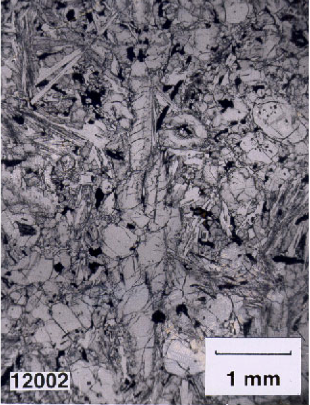
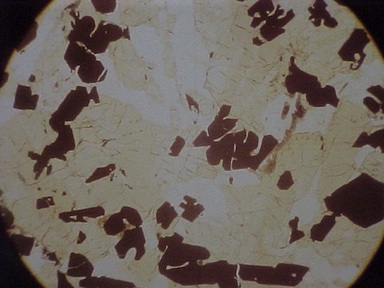
For example, here’s the expert opinion of Steven Dutch, professor of geology at the University of Wisconsin, who examined the Apollo samples personally and replied to the allegations of fakery in his review of the Fox TV Conspiracy Theory: Did We Go to the Moon? show (Uwgb.edu, 2001):

Water is ubiquitous on earth - it’s present in magma, rocks deep in the crust are changed by hot fluids, and rocks near the surface are altered by surface water. Olivine in particular is easily altered. In the second picture [Figure 10.2-5], the olivine is fractured but the fractures are absolutely clean. You simply do not see unaltered olivine on earth.

Figure 10.2-5. A cross-section of an Apollo Moon rock photographed by Steven Dutch, University of Wisconsin.


This could not have been faked. These rocks have grains easily visible to the unaided eye, which means they cooled slowly. To have made these materials synthetically would have required keeping the rocks at 1100 C for years, cooling them slowly at thousands of pounds per square inch pressure. It would have taken years to create the apparatus, years more to get the hang of making the materials, and then years more to create the final result. Starting from Sputnik I in 1957, there would not have been enough time to do it. And, you’d have to synthesize several different types of rock in hundred-pound lots.

...Why create absolutely water-free rocks? Nobody was expecting that - it would have been much easier to fake rocks with water in them (for one thing, you could use terrestrial rocks) and nobody would have been suspicious. And you’d have to put in exactly the right amounts of radioactive elements and daughter products to get the rocks to date radiometrically at 4 billion years old - older than any terrestrial rocks. And you’d have to anticipate the development of new dating methods not in use in 1969 and make sure those elements are present in the correct abundance. And it’s not like adding carrots to a stew, either. To mimic the results of potassium-argon dating, you’d have to add inert argon gas and trap it just in the potassium-bearing minerals, and in exact proportion to the amount of potassium.


10.1 Were the Soviets bribed to keep quiet?

IN A NUTSHELL: No. If so, why would they secretly build the giant N1 Moon rockets? And the silence-for-grain theory doesn’t hold up.


THE DETAILS: When a Moon hoax believer is asked to explain why the Soviets didn’t denounce the alleged US fakery, one frequent reply is that the Soviet government was silenced by a bribe it couldn’t refuse. Ralph Rene, in Nasa Mooned America!, claims that this bribe was a huge amount of grain sold below cost by the United States to Russia in 1972.

However, a little fact-checking of history files shows that there was no secret deal between the two rival countries: on the contrary, the Soviet Union contrived a clever plan to covertly purchase on the free market, through shell companies and in the course of a few weeks, 30% of the US grain crop and even managed to take advantage of the US government’s farming export incentives. The press aptly called this scam The Great Russian Grain Robbery, as a reference to the then-famous British great train robbery of 1963.

Contrary to Rene’s claims, the grain wasn’t sold below cost, but the huge purchase triggered a market rush which tripled the price within a year. The Russians even managed to pull a similar trick again in 1975.*

* What Land Crash? by Marcia Zarley Taylor, AgWeb.com (2007); Another Soviet Grain Sting, in Time, Nov. 28, 1977.


It should be noted that US grain sales to Russia were not unusual: smaller negotiated deals had been made even during President Kennedy’s term and West European countries had also been involved.

In other words, Rene is reversing cause and effect in order to make the events fit his preconceptions: the US didn’t sell the grain below cost, but rather the Russian purchase made grain prices rise later on.

There’s also a bigger picture to be considered: if a discounted sale of grain was really all it took to keep the Russians quiet and convince them to lose face in the space race, then why wasn’t this leverage used to obtain other, perhaps more useful results, such as keeping the Russians out of the Vietnam War or ending the nuclear arms race? Instead of solving a contradiction, Rene’s justification merely leads to an even bigger absurdity.

This bribery scenario also entails a further increase in the number of participants to the conspiracy and in the consequent risk of someone, sooner or later, spilling the beans: the Russians, too, would have to be in on the fakery and would have to keep the secret flawlessly for decades.

Moreover, if the Russians were paid off to let the US win the race to the Moon, why did they bother to design and build a rival Moon rocket, the giant N1 (Figure 10.1-1), and the lunar landing craft L3, which they would never use?


Figure 10.1-1. A Soviet N1 rocket under construction.


Chapter 10. Alternative realities

Sometimes Moon hoax proponents realize that their alleged evidence entails absurdities or contradictions and try to justify them with other allegations. This generates a vast web of accusations that go beyond the details of the Apollo missions and enter the realm of politics and history. If you need to discuss Moon hoax theories, it is advisable to be familiar with these alternative interpretations of reality in order to avoid their pitfalls and spot their fallacies.

The following pages present some of the most popular concepts of these alternative realities: in addition to showing their errors and contradictions, they are revealing examples of the conspiracist mindset.