In summary, here’s the best evidence that the Moon missions were authentic:
vast amounts of publicly available documentation, which can be cross-checked and has been validated by experts from all over the world for decades
highly complex and perfectly realistic radio and television signals
not a single confession or leak over decades
no objections by the rival Soviet regime
direct reception of voice communications from the Moon by professional and amateur radio astronomers
no objections by any expert in spaceflight, astronomy, astrophysics, radio communications or any other relevant field
carefully selected Moon rocks returned to Earth
reflectors placed on the Moon, which can be checked even today
recent photographs of the Apollo vehicles and instruments left on the Moon, which are consistent with the decades-old NASA documents of the lunar missions
pictures that could only be taken in the presence of an astronaut on the Moon and have been confirmed independently by non-US space missions
dust that behaves in the Apollo footage in a way that is possible only in a vacuum
astronauts walking in a way that is possible only in one-sixth gravity.
In view of all these facts, the inescapable conclusion is that the Moon hoax theorists are right about the Moon landings in one respect: it’s true, as they often say, that the technology of the 1960s was not up to the challenge.
Even the best visual effects of today often fail to recreate authentically and simultaneously all the physical phenomena observed in the original Apollo lunar footage.
For example, Michael Bay’s blockbuster Transformers - Dark of the Moon (2011), in which the Apollo 11 mission plays a key part and is reconstructed extensively, gets the lunar dust wrong: Neil Armstrong’s first step kicks up a cloud of dust, revealing that the scene was not shot in vacuum.
Figure 3.14-1. A still from Transformers 3 reveals a mistake in the special effects: the moondust billows instead of falling in arcs, as it should in a vacuum. Credit: Paramount Pictures.
The TV series From the Earth to the Moon (1998), produced by Tom Hanks, Ron Howard and Brian Grazer, is considered one of the most accurate reconstructions of the moonwalks, which were simulated in a huge soundstage by attaching large helium-filled balloons to a harness inside the spacesuits, so as to give the astronaut-actors a visual buoyancy similar to lunar gravity.
The sharply outlined shadows of the original Apollo images were obtained by lighting the entire set with a single light source: a 2-meter (6-foot) convex mirror onto which twenty of the most powerful spotlights available in the film business projected their beams. The production even featured an original lunar module, a leftover of the canceled Apollo 18, 19 and 20 missions. Yet despite these amazing efforts, the beautiful visual effects sequences of the show lack other phenomena, such as the correct behavior of lunar dust as the astronauts walk.
The IMAX documentary Magnificent Desolation: Walking on the Moon 3D (2005), also featuring Tom Hanks among its producers, finally got the moondust right and also solved the challenge of camera and set reflections in the mirror-finished spacesuit helmet visors. However, these feats were achieved by resorting to digital visual effects, which were not available in 1969.
Figure 3.14-2. Digitally generated moondust being kicked up by an astronaut in Magnificent Desolation: Walking on the Moon 3D. Credit: IMAX Corporation.
People who allege that the visual record of the Apollo missions was faked frequently claim that the astronauts’ gait on the Moon was simulated by using wires or slow motion or both.
In 2008, Discovery Channel’s Mythbusters show put this claim to the test. Adam Savage, one of the show’s hosts, donned a spacesuit replica and tried to simulate the lunar walk by slowing down the recording of his strides and by using a special harness that supported five sixths of his weight, simulating the Moon’s low gravity, which is one sixth of the Earth’s.
Figure 3.13-1. Mythbusters tries to simulate the astronauts’ gait by using wires and slow motion, and fails. Credit: Discovery Channel.
Both methods failed miserably. Direct comparison between the Apollo footage and the effect of wires and slow motion reveals glaring differences. The harness and wires reduce the effect of gravity on the fake astronaut’s body, but not on the items he is wearing or carrying, which dangle and swing under full Earth gravity, giving away the trick.
Slow motion instead slows all of the simulated astronaut’s movements, whereas the Apollo footage shows that the astronauts made quick arm, leg and hand motions as they walked on the Moon. Achieving this effect through slow motion would have required the fake astronauts to move impossibly fast so that their gestures would appear normal when slowed down.
There’s only one way to achieve on Earth the fluid motions of the astronauts and the slow oscillation of the items they carry that we see in the Apollo footage: flying in a special aircraft which traces rollercoaster-like parabolic arcs. Not unsurprisingly, the aircraft is known as Vomit Comet.
Figure 3.13-2. The Vomit Comet’s trajectory as described by Mythbusters. Credit: Discovery Channel.
By adjusting the aircraft’s speed and inclination appropriately, these arcs create brief periods during which the cabin conditions are equivalent to lunar gravity, just like a car driving at speed over a hill makes its occupants “float” for an instant. The effect is the best approximation of the zero- or low-gravity conditions of spaceflight. Indeed, this is how Apollo astronauts trained for their spacewalks and moonwalks. The same technique was used for some of the zero-gravity shots in Ron Howard’s great movie Apollo 13 and is still used today to train current astronauts.
Mythbusters performed flights that used this method and obtained footage showing a very smooth gait that exactly matches the Apollo moonwalk footage without resorting to wires or slow motion.
Figure 3.13-3. Mythbusters’ Adam Savage moonwalks in simulated one-sixth gravity in the padded cabin of the Vomit Comet. Credit: Discovery Channel.
One might wonder whether this method could have been used to shoot fake moonwalks in the 1960s, but there’s a catch: the low-gravity effect produced in this way only lasts a few seconds at a time. Moreover, it occurs within the cramped space of an aircraft cabin. The Apollo footage instead includes uninterrupted hour-long shots taken in very large spaces.
Also, we’ve seen that the visual record of the Moon missions shows phenomena that can only occur in a vacuum, such as the behavior of the dust. The cabin, therefore, would have to be a colossal top-secret flying vacuum chamber capable of hour-long parabolic arcs. Once again, flying to the Moon would have been easier.
Shooting fake Moon footage underwater might also be considered. Carefully adjusting the buoyancy of every single item carried and worn by the astronauts could provide a credible visual appearance of low gravity. However, this technique would require an immense and very deep tank filled with crystal-clear water, and a single stray bubble would reveal the fakery. Besides, in an underwater environment the simulated moondust would not fall back suddenly as it does in the Apollo footage: it would tend to float and swirl about, once again giving away the trick.
Indeed, the key problem of faking the Apollo moonwalk footage isn’t achieving a single visual effect, but achieving them all simultaneously and for long, unbroken sequences, which must all be perfectly consistent, because the TV footage must match the film footage and both must match the photos.
In a nutshell: in the 1960s, the only way to obtain footage of astronauts walking on the Moon as shown by the Apollo visual record was to actually go to the Moon.
And if the Apollo footage is authentic, so are the Moon landings.
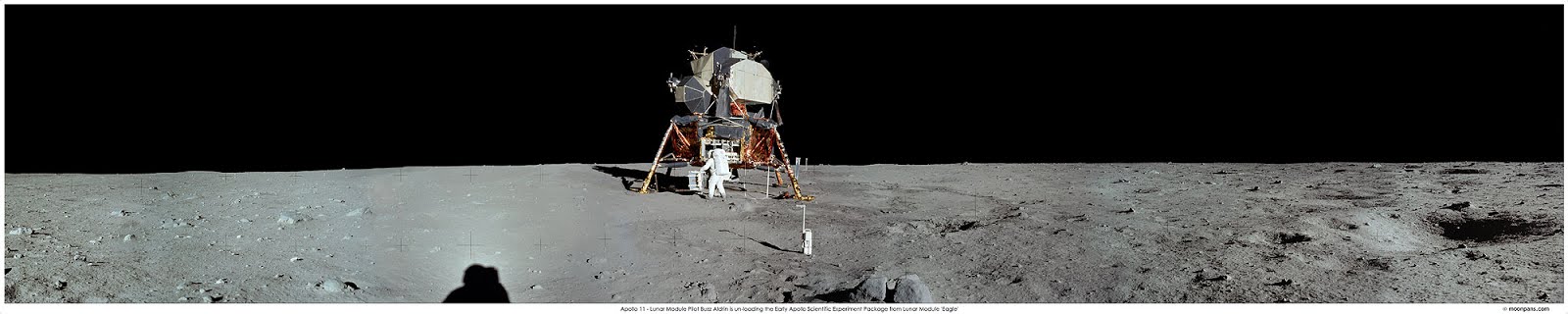
People who claim that the Moon mission footage was produced on a movie set often fail to consider that many Apollo photos were taken in sequences while the astronaut-photographer slowly turned around. Therefore, these pictures can be assembled into huge panoramic images, as shown below for the Apollo 11 mission.
Figure 3.12-1. Composite image based on a sequence of photographs taken by Neil Armstrong during Apollo 11 (AS11-40-5930/31/32/33/34/39/40). Credit: Moonpans.com.
Achieving the same result with special effects would have required a colossal soundstage. The movie set, moreover, would have had to be lit entirely by a single, high-power light source, because multiple lights would have produced multiple shadows.
There’s more. The Apollo missions that carried the Rover Moon car brought back footage from the onboard movie camera that shows the Rover traversing the lunar surface in uninterrupted sequences that last tens of minutes. For example, the color film footage known as Traverse to Station 4 from the Apollo 16 mission lasts 25 minutes without breaks (these long durations were achieved by using low frame rates).
This footage shows the changing surroundings and terrain under the Rover’s wheels, which kick up dust that falls sharply to the ground.
Achieving this effect by using Hollywood-style tricks would have required a colossal movie set, and since the Rover is seen kicking up fine dust that falls right back to the ground as it travels instead of forming a cloud, that giant movie set would have to be entirely in a vacuum. All this would have to be lit by a single light source.
Hoax proponents might suggest a highly sophisticated scale model of the Rover and of the lunar surface, placed in a manageably smaller vacuum chamber. But that would not explain uninterrupted video sequences such as the one in Figure 3.12-2, taken from the live television broadcast of the Apollo 16 mission: it shows astronauts (impossible to simulate with models) walking continuously away from the camera until they almost disappear from sight, despite the camera zooming in, without ever reaching the far end of the alleged movie set.
Figure 3.12-2. John Young and Charlie Duke (Apollo 16) walk from the Rover towards the boulder nicknamed House Rock, 220 meters (720 feet) away.
It is important to bear in mind that on the Moon there’s no atmospheric haze to blur the details of distant objects and provides a visual hint of distance and size. There are no familiar references, such as trees or houses, that can provide a sense of scale. Indeed, the rock that appears to be just behind the astronauts as they walk towards it turns out to be as tall as a four-story building (hence the name House Rock): as detailed in NASA’s Apollo 16 Preliminary Science Report, it is 12 meters (40 feet) tall, measures 16 meters by 20 (50 by 65 feet) at its base, and lies 220 meters (720 feet) from the television camera, which is mounted on the Rover.
It is really hard to imagine a colossal secret movie set, lit perfectly by a single light source, of such gigantic size as to allow such a long, uninterrupted walk and placed entirely in a vacuum.
For those who speculate that the Moon pictures were faked using painted backdrops to simulate the distant horizon, it should be noted that many Apollo photographs were taken as stereo pairs (by taking a first picture and then shifting the camera slightly sideways). These stereo pairs can be assembled digitally to produce 3D images or anaglyphs that clearly reveal the actual depth of the scene.
Several collections of these 3D photographs are available in NASA’s Apollo Anaglyph Albums and in the book Luna mai vista (Unseen Moon) by Roberto Beltramini and Luigi Pizzimenti. They can be viewed with glasses fitted with red-blue filters. The original picture pairs can also be edited by anyone to create a stereogram for glasses-free 3D viewing in color.
Figure 3.12-3. Detail of a stereoscopic panorama created by Roberto Beltramini starting from photographs of the Apollo 16 mission. To view it in 3D you need red-blue glasses. Source: Apollo 16 Image Library.
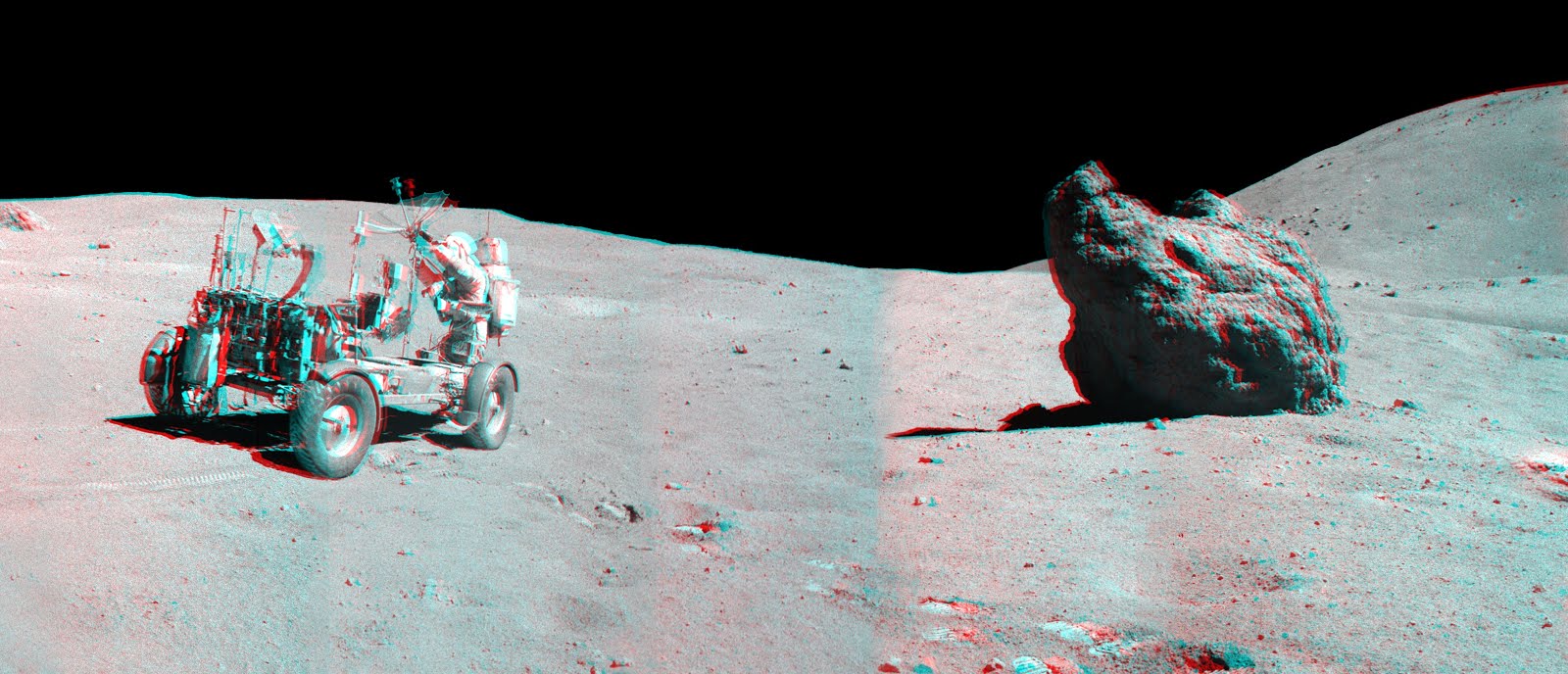
For example, the following 3D image, created by Erik van Meijgaarden from Apollo 17 photos, shows the Lunar Rover car in the foreground, at the so-called VIP Site where it was placed to televise the liftoff of the astronauts in the Lunar Module. The LM is in the background on the left.
Figure 3.12-4. Anaglyph of the Apollo 17 “VIP Site”. Credit: Erik van Meijgaarden.
If you look at this images with red-blue glasses, it becomes evident that the LM is quite far away and that the hills and mountains are even farther away. Achieving this effect on a 1960s movie set would have been impossible.
There’s another apparently trivial aspect of the visual record of the Moon missions that hoax proponents have great trouble explaining: the dust.
On Earth, the dust kicked up by the wheels of a car, for example, stays in the air for a long time, producing a long billowing cloud that dissipates slowly, such as the one shown below.
Figure 3.11-1. Dust cloud on a dirt road. Credit: PA.
However, in the color film footage of the astronauts’ electric car ride on the Moon the fine dust that it kicks up falls immediately to the ground in a parabolic arc. That’s because on the Moon there’s no air to brake its fall and keep it floating. This footage, therefore, must have been shot in a vacuum. This one of the best pieces of evidence proving that the visual record of the Apollo moonwalks was actually shot in an airless environment.
Figure 3.11-2. Apollo 16’s Rover kicks up dust, which exhibits an unusual behavior. Detail from a 16 mm movie film frame.
Figure 3.11-3. 16 mm footage of Apollo 16’s Rover.
This unusual behavior of the lunar dust also occurs on a smaller scale when the astronauts walk. At every step, the dust they strike with their boots fans out and falls sharply to the ground.
This effect is especially conspicuous in backlit TV and film footage of the Moon missions and can be glimpsed even in the footage of Apollo 11, the first lunar landing, as shown below.
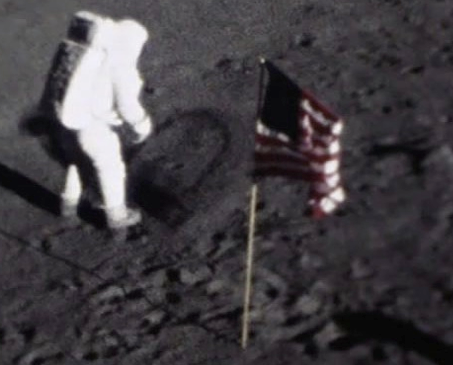
Figure 3.11-4. Detail from three successive frames of the 16 mm color film footage of Apollo 11’s moonwalk: Buzz Aldrin demonstrates the fanning and sharp fall of moondust as part of a series of experiments on the behavior of lunar soil.
While this effect can be rather difficult to perceive in still images, it is very clear in movies and TV recordings. Here are some examples.
Figure 3.11-5. TV and film recordings of moonwalks clearly show the behavior of moondust.
The weird behavior of the dust is also eloquent in the Moon landing footage. When the Lunar Module is about to touch the ground, the dust scatters horizontally in straight lines, propelled by the LM’s rocket exhaust, forming a thin, shallow mist that hides the details of the surface. As soon as the rocket motor shuts down, the dust settles suddenly, without billowing at all, and the ground becomes abruptly visible again.
Figure 3.11-6. The Apollo 11 landing in a frame from the 16 mm color movie footage.
How could all this have been achieved with the special effects technology of the 1960s?
Some hoax proponents have suggested the use of heavy, coarse sand, but nobody so far has been able to show that such sand actually behaves like the dust in the Apollo footage. It’s not just a matter of falling sharply without forming clouds: it also has to change the way it reflects the light when it is kicked up, becoming very dark in some lighting conditions and extremely bright in others, as occurs in the Moon mission television recordings and movies.
Another approach might have been to shoot footage of model spacecraft inside a vacuum chamber. NASA researchers actually used such a chamber to study how moondust would move when affected by a rocket motor blast in a vacuum: they were concerned that the descent motor would kick up so much dust that the crew would lose the ability to see.
Figure 3.11-7. Researchers observing a moon dust simulation inside a small vacuum chamber at the Lewis Research Center in 1960. Photo C-1960-53766 (cropped). Source: NASA/Glenn Research Center.
However, this method would have worked only for footage of the spacecraft. Any TV or film which showed moving astronauts, whose motions could not be reproduced by a scale model or a puppet, would have entailed placing an entire soundstage in vacuum, including the full-size astronaut actors, movie cameras, TV cameras, lights and stagehands.
This would have required a truly immense vacuum chamber, since some Apollo footage shows the astronauts and their electric car walking or driving uninterruptedly for hundreds of meters (yards). But even today, the world’s largest vacuum chamber, located at Plum Brook Station in Ohio, is only 30 meters (100 feet) in diameter. The Lunar Module alone would have filled one third of this chamber, leaving little room to walk around it.
Moreover, this special effect would have to be produced flawlessly at the same time as all the others, and for long, uninterrupted sequences. Again, it would have been easier and safer to actually go to the Moon.
It’s interesting to compare the Apollo lunar landing footage with the Moon landing shown in 2001: A Space Odyssey, a movie that at that time of its release in 1968 was the peerless state of the art in visual effects. The movie was directed by Stanley Kubrick, who is often mentioned by hoax proponents as the visual effects master who allegedly faked Apollo’s photographs, television broadcasts and film footage.
It turns out that the behavior of the dust in 2001 is hopelessly wrong: it floats and forms swirling eddies, as shown below. This means that the scene was shot in an atmosphere, not in a vacuum.
Figure 3.11-7. A Moon landing as depicted in 2001: A Space Odyssey (1968). Credit: MGM.
If this is the absolute best that could be achieved with the special effects technology of the 1960s, how did NASA fake the Moon footage?
The Kaguya/Selene automatic Moon probe, launched by the Japanese space agency JAXA, spent 20 months orbiting the Moon, ending its mission in 2009. Its laser altimeter had a vertical precision of 5 meters (about 16 feet), which allowed JAXA’s scientists to generate highly accurate digital 3D maps of the Moon’s surface. The map data are available at Kaguya’s website.
Figure 3.10-1. Artist’s rendering of the Japanese Kaguya probe and of its two subsatellites, Okina and Ouna. Credit: JAXA.
The highly detailed pictures from Kaguya’s camera can be combined with the altimeter’s 3D terrain measurements to generate virtual views of the moonscape as seen from any point on or above the lunar surface.
The Japanese space agency’s engineers tested Kaguya’s systems by comparing their results with NASA’s, using only their own data to generate a digitally rendered view of the lunar surface as it would appear if the observer stood at the site where the Apollo 15 astronauts took a series of photographs in July 1971 and looked in the same direction as they did. The comparison is shown below and speaks for itself.
Figure 3.10-2. Left: a detail of NASA photo AS15-82-11122, taken in 1971 by the crew of Apollo 15. Right: the digitally rendered view from the same spot on the Moon, based on the 3D maps and photographs generated from the data of Japan’s Kaguya probe in 2009.
The object on the far left in the NASA photograph is a portion of the Lunar Rover, the electric car used by the astronauts. Indeed, the other photographs of the NASA sequence include astronaut David Scott, who is working on the Rover, as can be seen in the composite picture shown below.
Figure 3.10-3. Composite image of NASA photos AS15-82-11120, AS15-82-11121, AS15-82-11122 from the Apollo 15 mission (1971). The astronaut leaning over the Rover is David R. Scott.
In other words, in 1971 NASA published photographs that showed a lunar mountain range seen from a specific point on the surface of the Moon and included an astronaut and his vehicle. Thirty-eight years later, a Japanese probe went to the Moon, scanned that same mountain range and found that the view from that specific location matches exactly what NASA had shown nearly four decades earlier in the Moon landing pictures. How did NASA know in 1971 what that ground view looked like? How did it get a Rover and an astronaut in the picture?
Perhaps NASA secretly carried to the Moon a Rover, a dummy dressed in a spacesuit, and a robot that set them in position, took their photograph and returned the high-resolution film to Earth. But that would imply that in 1971 the US space agency was already capable of performing extremely complex Moon missions with substantial payloads. But if it had such an advanced capability, then it would have been able to put real astronauts on the Moon.
Or maybe the US sent an automatic probe to the Moon in 1971 or earlier and gathered high-precision altimetric data of the contour of the lunar surface, or took photographs from ground level, and then built movie sets that replicated exactly the actual appearance of each Moon landing site.
But it would be ludicrous to think that a government organization could carry out successfully such a complex operation in absolute secrecy, and do so six times, involving inevitably a very large amount of people to create the fakery, without anyone ever making mistakes or revealing too much, without ever losing any of the paperwork involved, and with the risk of catastrophic humiliation in case of a slip-up.
It would have been far easier to actually go to the Moon, and it would have been politically safer: even in case of failure, at least there would have been no danger of being caught faking it.
So far we’ve seen strong indications of the authenticity of the crewed Moon landings, which are quite convincing for anyone who considers the balance of evidence. They show that any attempt at fakery would have been absurdly complicated, but they aren’t proof, strictly speaking. Certainly they’re not definitive proof for a hardcore Moon hoax believer.
If we’re looking for proof, what we need is something that demonstrates beyond doubt that in 1969 there were no bizarre robots in boots hopping around on the Moon, but that human beings were actually there. Something that documents an event that could have occurred only on the Moon half a century ago and in the presence of astronauts. Something preferably provided by an independent source, not by NASA.
Can’t we simply point a telescope at the Moon and see if the Apollo vehicles are there? It’s one of the most frequent and common-sense questions regarding Moon hoax theories.
The answer, unfortunately, is no: even the world’s most powerful telescopes are currently unable to resolve such tiny objects at the distance of the Moon, for reasons detailed in Chapter 7. However, if a telescope were placed closer to the Moon, for example on an uncrewed space probe, it could take pictures of the sites where NASA claims to have landed.
Actually, this has already been done. In 2009, NASA’s Lunar Reconnaissance Orbiter probe began a high-resolution survey of the entire Moon which is still in progress today. The probe’s state-of-the-art mapping camera has taken many photographs of the landing or crash sites of many US and Soviet space probes, including the Apollo spacecraft. In 2011 it flew as low as 22 kilometers (13.6 miles, 72,000 feet) in the vicinity of some of the Apollo sites and imaged details as small as 0.25 meters (about 10 inches).
Figure 3.8-1. Artist’s rendering of the Lunar Reconnaissance Orbiter.
The LRO images of the Apollo landing sites show that the descent stages of the Lunar Modules and the equipment left on the Moon by the astronauts are still there today, exactly where NASA described and documented them with on-site photographs, TV and movie footage so many decades ago.
These images even show the parallel tread marks left by the wheels of the Rover and the lines of footprints produced by the astronauts. On the Moon there’s no wind or rain to make them fade, so they’re still there right now.
The figures below, for example, are photographs of the Apollo 17 landing site taken by the LRO in 2011. They show the descent stage of the Lunar Module Challenger. Its sharp shadow reveals how high it protrudes above the surrounding surface. The ground around the LM is darker because it was disturbed by Gene Cernan and Harrison Schmitt’s boots.
Figure 3.8-2. The descent stage of Apollo 17’s Lunar Module, photographed on the Moon by the LRO probe in 2011. Credit: NASA/GSFC/Arizona State University.
Figure 3.8-3. Detail of the Apollo 17 LM descent stage imaged by the LRO probe in 2011. PLSS indicates the astronauts’ backpacks; MESA is the tilt-down equipment stowage compartment on the descent stage; Pallet is the payload transport pallet. Credit: NASA/GSFC/Arizona State University.
The Lunar Reconnaissance Orbiter has imaged the Apollo landing sites repeatedly and is still doing so periodically. For example, the larger white spot in Figure 3.8-4 is the descent stage of the Apollo 11 Lunar Module and the four dots around it are the LM’s footpads, in different lighting conditions: respectively, with the sun at a low angle and at a high angle to the local horizon, thus casting long and short shadows.
The arrows indicate the television camera (TV), the retroreflector (LRRR), the seismograph (PSE) and the line of footprints left by Neil Armstrong when he dashed to Little West crater, about 60 meters (200 feet) from the LM, and took a series of photographs, such as AS11-40-5961, as attested by the radio communications recordings and by the mission reports. The TV recordings show the initial part of Neil’s dash.
Figure 3.8-4. Top: the descent stage of Apollo 11, photographed by the LRO with the sun at a low angle to the horizon in 2011. Bottom: the same site imaged with the sun almost overhead in 2009. Credit: NASA/GSFC/Arizona State University.
Figure 3.8-5. Neil Armstrong on the rim of Little West crater. The thin shadow on the right is cast by the ALSCC instrument (stereo macro camera for geology imaging). NASA photograph AS11-40-5961.
That’s the level of cross-checking allowed by the Moon landing data. And there’s more.
The LRO photographs of the Apollo 11 site can be compared with the lunar excursion map published in 1969 by NASA, which details the locations of the items left on the Moon and traces the astronauts’ movements. It turns out that all the objects, the bootprints and the terrain details we find on the Moon today are almost exactly where NASA said they were over four decades ago.
Figure 3.8-6. Comparison between the Apollo 11 Traverse Map (1969) and a site photograph taken by the LRO probe (2009). Credit: NASA/GSFC/Arizona State University.
The Apollo 11 landing site has been photographed by the LRO so many times through the years that it is possible to combine the photographs into an animation which shows the Lunar Module descent stage in various lighting conditions, clearly bringing out its three-dimensional shape and its details.
Figure 3.8-7. Animation of LRO images of the Apollo 11 landing site. Changes in lighting clearly show the LM casting a shadow and catching sunlight. Credit: NASA/GSFC/Arizona State University, 2018.
Figure 3.8-8. Another animation of LRO images of the Apollo 11 landing site. This image sequence is rotated 90° counterclockwise with respect to Figure 3.7-7. Credit: NASA/GSFC/Arizona State University.
The following figures are images of other Apollo landing sites taken by the LRO.
Figure 3.8-9. The Apollo 12 landing site, imaged by the LRO probe in 2011. Credit: NASA/GSFC/Arizona State University.
To better understand the details of these images of the Apollo landings site it can be useful to refer to Figure 3.8-13, which is a digitally edited photograph from the Apollo 16 mission. It shows how the LM descent stage would appear after the crew lifted off in the ascent stage:
Figure 3.8-13. Digitally edited version of NASA photo AS16-107-17435 (Apollo 16) showing the likely appearance of a lunar module after crew liftoff. Credit: Joel Raupe (@LunarPioneer).
Figure 3.8-14. The full, unretouched source of Figure 3.7-12: NASA photo AS16-107-17435.
This digital artist’s impression highlights the little-known fact that the four exhaust plume deflectors, used to prevent the exhaust of the maneuvering motors from striking the spacecraft and damaging it, were part of the descent stage and therefore were left on the Moon. Today they rise above the descent stage and form shadows on its top.
---
Someone might object that the LRO is a NASA probe and therefore cannot be trusted. Actually, NASA only launched the probe: the LRO’s camera and the analysis of its images are managed by a separate academic group, the LROC Science Operations Center at the Arizona State University, together with other scientific organizations. The LROC website provides the full list of participants.
All these people, too, would have to be part of the massive cover-up, or someone would have to fake all the pictures that keep coming from the Moon. The fakery would have to be so perfect that the researchers at the Arizona State University and elsewhere wouldn’t realize they were being duped. Considering that they’re digital imaging analysis experts and that fake images would have to be generated whenever the LRO flies over the six Apollo landing sites and would have to take into account the ever-changing sun angle, that’s quite a substantial challenge.
A single slip in any point of this process would reveal the entire decades-old conspiracy to the world, because the Lunar Reconnaissance Orbiter pictures are regularly posted on the probe’s website.
It strains credulity to claim that any government agency could attain and maintain this level of absolute secrecy and perfection for so many decades.
Another, perhaps more sensible objection might be that the LRO photographs only show the vehicles, but obviously not the astronauts. But if so, how were the bootprints made? Did NASA secretly send a robot with boots to the Moon, to trace the exact patterns faked on the movie set? Six times?
The “mirrors” placed on the lunar surface by the astronauts are another frequently cited example of evidence of the crewed Moon landings. Actually, they’re not mirrors, but arrays of high-precision prisms, known as retroreflectors, that reflect light exactly in the direction from which it came, like a bicycle reflector.
Figure 3.7-1. The Apollo 11 retroreflector. Detail from photo AS11-40-5952.
These passive devices, requiring no onboard power for their operation, were placed on the lunar surface by the crews of Apollo 11, 14 and 15. Even today, scientists can fire a high-power laser beam from Earth to the locations of these retroreflectors on the Moon and detect the light that they reflect back. The time it takes for the light to complete the round trip allows researchers to measure the Earth-Moon distance to within a few centimeters (inches) and to conduct many astronomy- and gravity-related studies.
One of the retroreflectors built for the Apollo program is on display at the National Air and Space Museum in Washington, DC.
Figure 3.7-2. High-power laser beams fired at precise locations on the Moon from the Goddard Geophysical and Astronomical Observatory strike the Apollo retroreflectors. Credit: NASA, 2007.
Strictly speaking, however, these devices cannot be used as indisputable evidence of crewed Moon landings, because the Russians managed to place their own retroreflectors on the Moon by using uncrewed probes (Luna 17 and Luna 21, in 1970 and in 1973). But they do prove that the United States, in 1969 and in 1971, were actually able to somehow place these instruments exactly where they claim to have landed astronauts on the Moon.
The 382 kilograms (842 pounds) of handpicked samples of Moon rock brought back by the six crewed landings are often mentioned as evidence that astronauts walked on the Moon. The nonterrestrial nature of these over 2,000 samples has been confirmed by the studies conducted by geologists from all over the world during the last forty years.
The photograph below shows one of these alien samples, known as the Genesis Rock because it is approximately four thousand million years old and is one of the most ancient rocks ever found. Dave Scott and James Irwin collected this 269-gram (9.5-ounce), 9-centimeter (3.5-inch) sample during Apollo 15.
Figure 3.6-1. The Genesis Rock returned from the Moon by Apollo 15.
A hardcore Moon hoax believer might object, however, that the Soviets, too, brought back rock samples from the Moon by using the Luna 16, 20 and 24 automatic probes, launched between 1970 and 1976. Therefore it would be fair to argue that maybe the US did the same. Indeed, strictly speaking, the lunar rocks prove that the United States sent vehicles to the Moon but don’t necessarily prove that astronauts went to the Moon.
Figure 3.6-2. A Soviet Luna probe equipped for Moon soil sample return.
However, there are substantial differences between the Soviet and American sample returns that allow us to include the Moon rocks among the evidence of human lunar landings.
First of all there’s quantity. The total weight of all the Moon rock samples collected by the Russian robotic probes is 326 grams (11.5 ounces); the American samples weigh over a thousand times more. This difference highlights the huge gap in performance between US and Soviet spacecraft. It shows that NASA was capable of sending to the Moon and returning home a far larger payload per mission than its Russian counterpart. Apollo 17 alone brought back 110 kilograms (242 pounds) of samples.
At the very least, this undermines the conspiracists’ claims that the Saturn V booster was an inadequate Moon vehicle. If a single Saturn V rocket and the Apollo spacecraft were capable of returning 110 kilograms (242 pounds) of lunar rocks, it stands to reason that they were capable of carrying at least one astronaut to the Moon and back.
Then there’s quality. The Soviet “rocks” are actually little more than coarse grains like the one shown below, which is 2.5 millimeters (one tenth of an inch) long. It’s smaller than a grain of rice. Moreover, the Soviet samples were not selected in any way.
Figure 3.6-3. A sample of the lunar surface returned to Earth by the Soviet Luna 20 uncrewed mission in February 1972 and loaned for examination to geologists from Caltech, Oregon State University and University of Chicago. Credit: Engineering and Science, May-June 1976, page 19.
By contrast, the highly diverse Moon rocks returned by the United States weigh up to 11 kilograms (24 pounds) each. Some are core samples taken by drilling up to 3 meters (9 feet) into the ground. The best the Soviets managed was a core sample weighing all of 170 grams (six ounces). It was the only sample returned by the Luna 24 mission, and this was achieved in 1976, seven years after Apollo 11.
How could all this have been achieved? Is it more likely that the US somehow, in the 1960s, had incredibly advanced secret robotic technology, or that it sent astronauts to the Moon with the geological knowledge and the right tools to choose the rocks and drill the core samples manually?
One more thing. Moon hoax believers who raise the issue of the Soviet lunar samples paint themselves into a corner, because Soviet samples are geologically identical to the ones returned by the Apollo missions and are different from Earth rocks. In other words, the Soviet rocks authenticate the American ones. Which means that any hoax believer who mentions the Russian Moon samples can’t claim that the Apollo rocks are fakes.
Further evidence that astronauts actually went to the Moon is the fact that their radio communications could be received by anyone on Earth with suitable equipment. Sven Grahn, scientist and researcher for the Swedish space program and expert radio tracker of spacecraft, followed Apollo 17’s flight to the Moon with a 9-meter parabolic dish antenna in 1972. His team was able to pick up astronaut Ron Evans‘ voice communications from the Command Module as it orbited around the Moon. The technical details of this achievement and of the radio signals sent by the Apollo spacecraft are published in his article Tracking Apollo-17 from Florida.
Figure 3.5-1. Assembly of a 9-meter dish near Gainesville, Florida, to pick up Apollo 17 radio communications, November 1972. Credit: Sven Grahn.
The Italian radio telescope at Arcetri, near Florence, picked up the voice communications of the Apollo 11 astronauts as they descended to the Moon. Professor Guglielmo Righini, director of the observatory, and chemistry-physics professor Salvatore Califano of the University of Florence, vividly describe their scientific eavesdropping on the conversations of the Apollo astronauts:
Professor Righini explained that at Arcetri, the physicists from Florence followed the American space endeavor from its beginning, staying permanently in indirect contact with the spacecraft and listening to the conversations of the astronauts when they occurred on a particular wavelength to which the Arcetri instrument was tuned and when, before the Moon landing, the American spacecraft orbited around the near side of the Moon. -- Attraverso i sassi lunari studieremo il sistema solare, by Carlo Degl’Innocenti, in L’Unità, 22 July 1969, page 5.
These signals are very strong evidence that the Apollo spacecraft actually did go all the way to the Moon for several reasons. First of all, the very large antennas used by these non-NASA receivers are highly directional: in other words, they only hear signals that come from the very small spot in the sky towards which they are pointed. If the Apollo signals were picked up by the antennas while they were pointed at the Moon, the signals had to come from the Moon. These signals could not arrive from, say, an Earth-orbiting artificial satellite, because such a satellite would have move in the sky much faster than the Moon in order to stay in orbit.
Secondly, the Apollo signals exhibited Doppler shift: their frequency shifted when they moved periodically towards and away from the receivers as the spacecraft orbited around the Moon. The values of this shift allowed to determine the speed of the vehicles and confirm that they were orbiting around the Moon at the speed and distance stated by NASA or had landed on the Moon.
In other words, voices from the Moon were received independently on Earth by researchers. Anyone claiming a conspiracy would therefore have to explain, in technical detail, how these signals could be faked so well as to fool scientists or would have to accuse Sven Grahn and professors Righini and Califano of being liars.
As detailed in Chapter 1, the Soviets attempted to land a cosmonaut on the Moon ahead of the Americans. The two superpowers’ standing in the world was at stake and a show of technological prowess would send a clear message to non-aligned countries that the Soviet Union was a powerful, modern and determined state that it would be wise to have as an ally. But the costly Russian attempt failed catastrophically and was kept secret. The Soviet government pretended that it had never tried to set foot on the Moon.
Therefore, if the Soviet Union had discovered that the American Moon landings had been faked – something which it was well equipped to do, through both radio eavesdropping and espionage – it would have had excellent reasons to reveal any American trickery and thus publicly humiliate its rival and enemy, providing irrefutable evidence, as it had during the U-2 incident in 1960.*
* As mentioned in Chapter 1.3, when the CIA realized that it had lost one of its secret U-2 spy planes over the Soviet Union, NASA released a cover story claiming that it was one of its weather research aircraft that had gone off course due to a malfunction, but the Soviets (who had shot the plane down) later presented the unmistakable military reconnaissance equipment found among the wreckage and revealed that they had captured the pilot, Francis Gary Powers. This led to a devastating political and diplomatic humiliation for US president Eisenhower, and nobody questioned the Soviet revelations.
But the Soviet government didn’t dispute the landings. On the contrary, in an unprecedented gesture, Soviet state television announced Apollo 11’s Moon landing and even broadcast excerpts from the mission’s moonwalk. The Soviet state newspaper, Pravda, mentioned the moon landing on its front page on July 21, 1979. Soviet state-controlled media covered the mission extensively.
When the crew returned to Earth, Moscow Radio began its evening newscast by reporting that “the courageous astronauts, Armstrong, Aldrin and Collins are again on our planet”.
Soviet head of state Nikolai Podgorny wired US president Nixon after the Apollo 11 splashdown: “Please convey our congratulations and best wishes to the courageous space pilots.”
Many countries of the Soviet bloc issued stamps celebrating the Apollo 11 mission.
Figure 3.4-1. A Romanian stamp series describes Apollo 11 as the “first Moon landing of a human crew”.
Figure 3.4-2. A 1977 stamp from Czechoslovakia. Credit: 123rf.com.
The Great Soviet Encyclopedia, published in 1970, dedicated two pages to the Apollo flights and half a column to Neil Armstrong’s biography.
After the collapse of the Soviet Union, several key figures of the country’s space program, such as designers Vasily Mishin and Boris Chertok, wrote books explaining the reasons for the failure of Soviet crewed lunar efforts and commended the success of the American missions that put astronauts on the Moon.
Figure 3.4-3. The front cover of the French edition of Vasily Mishin’s book on the failure of the Soviet lunar program, entitled Why we didn’t go to the Moon (1993).
Through the decades that have passed since the Moon landings, not one of the approximately 400,000 civilian technicians and engineers of the many aerospace companies who worked on the Apollo project has ever spilled the beans, not even by mistake or in a moment of alcohol-fueled exuberance.
No deathbed confessions, no leaked dossiers, no compromising photographs revealing the fakery. Even the Mafia can’t achieve that level of airtight silence and secrecy. By contrast, the Soviet Union’s top-secret Moon landing project and its humiliating failure, described in Chapter 1, became public within twenty years, despite the fact that they occurred in a closed totalitarian regime with sprawling censorship and secrecy systems.
Figure 3.3-1. Some of the engineers who built the Lunar Modules. Credit: Lawrence A. Feliu, Northrop Grumman History Center.
Conspiracy theorists occasionally announce that they have uncovered official documents, photographs or film footage that allegedly have been faked or somehow prove their claims. However, it has always turned out that the fakery was actually on the part of the hoax proponents or that these self-proclaimed detectives had cluelessly misinterpreted their findings, as any spaceflight expert would have told them if they’d bothered to ask.
Moreover, the incredibly tight-lipped engineers of the Apollo project aren’t nameless faces: they’re real people. Their names are public. They’re civilians, not military personnel accustomed to secrecy. Many of them are still alive and quite willing to talk and write about their experience and work on the Moon missions. Yet no conspiracy theorist seems to be willing to accuse them individually, to their face, of faking the Moon landings.
Also, the Apollo project didn’t just involve Americans. Scientists and engineers from all over the world took part in the science experiments and communications. The solar wind experiment was managed by Swiss researchers. The telemetry, television and radio links with the spacecraft were relayed by Australian and Spanish tracking stations. The knowledge gained from the Moon landings has been shared for decades with scientists of all countries. Subsequent uncrewed Moon missions of many countries relied on Apollo data. European astronauts have been trained by Neil Armstrong and other moonwalkers. Are all these skilled professionals too dumb to realize they’ve been hoodwinked all this time?
Left to right: Ted Knotts, Richard Holl and Elmer Fredd celebrate in front of the Scan Converter at Sydney Video. The monitor is showing the Apollo 11 live broadcast. Aldrin and Armstrong are safely back inside the LM. Photo courtesy of Colin Mackellar, Honeysucklecreek.net.
A very good example of how all this technical material can be examined, verified and checked for consistency, even in unexpected ways, is the research conducted in 2009 by an Italian physicist, Luca Girlanda, and by the students of two high schools in his country.*
* Echoes from the Moon, Luca Girlanda, INFN Sezione di Pisa, in American Journal of Physics, September 2009, vol. 77, Issue 9, p. 854-857.
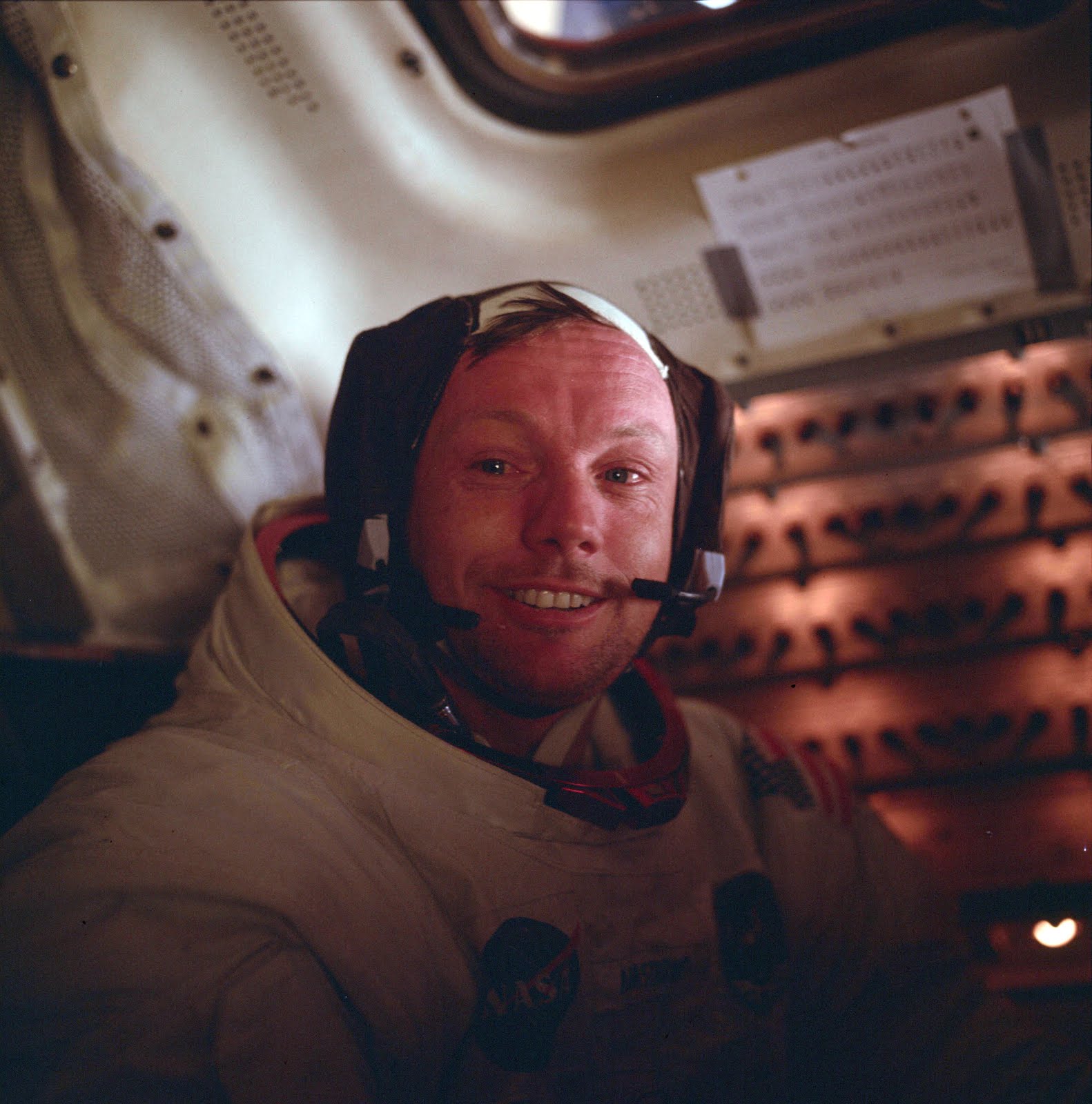
They downloaded from NASA’s website the recordings of the radio communications of the Apollo missions from the Moon and noticed that the transmissions included an echo of the voices of Mission Control on Earth. The echo was caused by the fact that the radio signal from Earth reached the astronauts’ headsets and was picked up by their microphones, so it was retransmitted back to Earth.
Figure 3.2-1. Neil Armstrong in the LM, tired but clearly pleased after mankind’s first moonwalk. Note the twin microphones close to his mouth. Photograph AS11-37-5528.
The students timed this round trip, which occurred at the speed of light: about 2.6 seconds for the Apollo 11 transmissions from the Moon. They also took into account the variations caused by Earth’s rotation and by the fact that the transmitter and the receiver were not located in the geometric center of the respective celestial bodies. Then they calculated that this delay implied an Earth-Moon distance of approximately 393,000 kilometers (245,000 miles).
However, the Moon’s distance from the Earth changes in the course of its monthly orbit around our planet from 363,100 to 405,700 kilometers (225,600 to 252,100 miles). That’s quite a large variation, which causes the round-trip radio delay to also vary between 2.4 and 2.7 seconds. So what was the exact Earth-Moon distance on July 20, 1969? Astronomers can compute the answer: 393,300 kilometers (244,400 miles). In other words, the radio delay that has remained dormant for decades in NASA’s recordings is exactly what it should be.
A Moon hoax believer might object that introducing a fixed delay in the radio recordings would have been fairly easy. But there’s more. The same high-school students also checked the radio communications of later missions, such as Apollo 17, which remained on the Moon for longer periods, and found that in NASA’s original recordings the delay is variable and matches exactly the variations of the Earth-Moon distance during that period. That’s the kind of minute detail that any hypothetical fakery would have to take into account and get right.
The United States’ crewed Moon landing program generated an immense amount of documents: technical manuals, plans and blueprints for even the tiniest spacecraft part, thousands of science articles, checklists, procedures, measurements, budgets, audits, contracts, purchase orders, inspection reports, press kits, mission reports, medical reports, experience reports, sample analyses, full transcripts of communications, and much more.
This documentation includes high-quality photographs, radio and television broadcasts, color film footage, telemetry data, and ground-to-air and onboard audio recordings.
Figure 3.1-1. An example of the vast documentation of the Moon missions: a landing site selection study dated 1965.
Figure 3.1-2. Another example of the publicly available Apollo documents: an excerpt from a study on landing site locations and stay times.
The six Apollo Moon landings generated 6,175 photos and dozens of hours of TV recordings and movie camera footage. That’s just the amount of pictures and footage taken on the lunar surface, excluding the rest of the trip, which would bring the total to roughly 20,000 photographs.
All this material has been publicly available for decades to anyone who asked for it and paid for duplication costs. Today it’s also available on the Internet, on digital media or on paper (see the References section at the end of this book). Apart from occasional typos and minor errors, it is all completely self-consistent and in agreement with the space research conducted by other countries.
These documents have been studied for decades by the world’s leading researchers and are the basis for countless science and technology innovations that we use every day, from GPS navigation to mobile phones. These inventions wouldn’t work if they were based on fake data.
Today NASA’s reports and data can be analyzed with techniques that didn’t even exist at the time and that any 1969 fakery accordingly would have been unable to preempt. If they had been forged, the world’s experts would know. Moreover, achieving such a massive, perfectly consistent and future-proof forgery would have been probably harder than actually going to the Moon.
Cross-checks
Rather amusingly, the most significant technical error found in decades of expert examination of the Moon landing documents is that NASA claimed incorrectly that there were no photographs of Neil Armstrong walking on the Moon and that all the photos of the historic first moonwalk of Apollo 11 showed his crew mate Buzz Aldrin. Quite an embarrassment, considering that Armstrong was the commander of the mission and the first man to set foot on the Moon’s surface (Aldrin joined him a few minutes later).
But in 1987 two researchers, H. J. P. Arnold and Keith Wilson, cross-checked the Apollo 11 radio communication transcripts and the astronauts’ reports and realized that some of the photographs actually showed Armstrong and not Aldrin as NASA had claimed [Spaceflight, August and December 1987; AS11-40-5886, by Eric M. Jones, Nasa.gov (1995)].
The mistake was partly due to the fact that the moonwalk plan explicitly prescribed that only Armstrong would take photographs of Aldrin, but not vice versa. Moreover, the astronauts’ spacesuits had no identifying markings apart from small name tags (starting with Apollo 13, this was fixed by providing the commander’s suit with conspicuous red bands).
Thanks to this research, today we know that there are six full-figure or partial photographs of Neil Armstrong on the Moon: the best one is AS11-40-5886 (Figures 3.1-3 and 3.1-4). Not much of a snapshot, but it’s better than nothing. Most of all, it shows that independent cross-checks on mission data are feasible and effective and that NASA’s word is not accepted unquestioningly.
Figure 3.1-3. Photo AS11-40-5886 shows Neil Armstrong on the Moon.
Figure 3.1-4. Neil Armstrong on the Moon. Detail from photo AS11-40-5886.
It’s also worth noting that NASA’s error was found not by Moon hoax theorists, but by expert researchers, well-versed in spaceflight history, who patiently checked their sources and facts.
Unfortunately, this mislabeling went uncorrected for eighteen years, allowing it to spread and fueling the conjecture that Aldrin refused to take photographs of Armstrong out of spite because he had not been chosen to be the first man to set foot on the Moon.
The other photographs of Neil Armstrong on the lunar surface are:
Armstrong is also clearly visible in the Apollo 11 television and film footage.
The tale of this error prompts a question for Moon hoax believers: if the photographs of the first Moon landing were faked for propaganda reasons, then how come NASA didn’t fake at least one iconic shot of the first man on the Moon that it could feed to the media?
The photographs
Many people believe that the Moon landings, especially the early ones, took only a handful of grainy, washed-out photographs, because that’s what the media usually show, often relying on poor transfers of old copies instead of using pristine digital scans taken directly from the originals.
Actually, the first lunar landing mission, Apollo 11, took 340 high-quality photographs while on the surface of the Moon (217 from inside the LM and 123 during the actual moonwalk).
The other trips took even more pictures on the lunar surface:
Apollo 12: 583
Apollo 14: 417
Apollo 15: 1151
Apollo 16: 1787
Apollo 17: 2237
The six Moon landings took a total of 6.515 photographs from the lunar surface. There are also thousands of photographs taken during the flights before and after the actual Moon landings. The grand total is about 19,700.
For many years, books, magazines and newspapers simply used the most dramatic and spectacular photographs of this vast collection and ignored the rest. But today the Internet makes it possible to distribute the entire set of photographs at virtually no cost and reveal the true variety and quality of these historic images.
Their detail is indeed superbly fine. The lunar astronauts used black-and-white and color film in 70 mm format, with three and a half times the area of regular 35 mm film: the same format used by most professional photographers at that time. Their main cameras were custom-built by Hasselblad and mounted Zeiss lenses: the state of the art in mobile photography in the 1960s.
Figure 3.1-5. Armstrong, Collins and Aldrin inspect 70 mm film rolls. NASA photograph AP11-69-H-1247.
Figure 3.1-6. A Hasselblad 500EL lunar camera.
All these films are still carefully preserved by NASA in a low-temperature vault at the Johnson Space Center in Houston and have been painstakingly digitized. The resulting scans are freely available online with resolutions of up to 4400 x 4600 pixels from websites such as Apolloarchive.com and Eol.jsc.nasa.gov and in books such as Norman Mailer’s Moonfire.
These high-quality scans restore the original colors and detail to the Apollo photographs, offering us today a far more complete, fresh and spectacular vision of the lunar excursions of four decades ago than was available to most people at the time of the Moon missions. Moreover, these pictures, besides being a beautiful testimony to the endeavor, allow anyone to cross-check the internal consistency of the documentation of the lunar landings.
For example, AS11-40-5903 (the famous “tourist photo” of Buzz Aldrin taken by Neil Armstrong during the Apollo 11 mission) is often published in the format and quality shown below.
Figure 3.1-7. The classic photograph of Buzz Aldrin on the Moon, AS11-40-5903, as shown online by the JSC Digital Image Collection.
But if you examine the direct scan of the original film frame (Figure 3.1-8), you find very different, sharper colors and a much wider view, which includes a footpad of the Lunar Module and one of the rod-like probes used by the LM as a ground contact sensor. These probes were located under three of the LM’s four circular feet and were bent during landing.
Figure 3.1-8. A higher-quality, full-frame scan of the same photograph, AS11-40-5903. Source: Eol.jsc.nasa.gov.
It also turns out that the original shot is quite tilted. Apollo 11’s Moon camera didn’t have a viewfinder: the astronauts took their pictures by pointing it roughly in the intended direction and relying on the wide viewing angle of the lens. This method usually worked, but in this case Neil Armstrong almost beheaded Aldrin, in the best tradition of tourist snapshots the world over. Indeed, Aldrin’s stick-like radio antenna, located on the top of his backpack, is cropped. For all these reasons, this photograph is often printed in the media by straightening it and adding a portion of fake black sky at the top.
The high-quality scan reveals many details of the image that had been wiped out by the excessive contrast introduced by repeated analog duplication processes. It also restores the original clarity of the picture all the way to the horizon, with none of the fading caused by atmospheric haze in pictures taken on Earth, clearly indicating that the photograph was taken in a vacuum.
Also, the direction of the shadows and the inclusion of the footpad and probe of the Lunar Module allow us to locate Aldrin with respect to the vehicle.
Aldrin is standing with the sun behind him and to his left, but the sunlight reflected by the daylit surface all around him and by the metallic film that covers the LM fills in the shadows on his bright white suit.
These higher-resolution scans allow us to explore the Apollo photographs in ways that are entirely impossible with the usual media prints. For example, Aldrin’s reflective visor holds the distorted mirror image of his surroundings. With this image quality and with today’s digital imaging tools, it becomes possible to analyze the reflection.
The photograph can be flipped to reverse the mirroring effect and then color-corrected to remove the gold hue of the visor, obtaining the detail shown below.
Figure 3.1-9. The reflection in Aldrin’s visor in photo AS11-40-5903, reversed and color-corrected, reveals Aldrin’s view. Credit: NASA, Kipp Teague, Apollo 11 Image Library.
This reveals the scene from Aldrin’s viewpoint: the LM to the left, Neil Armstrong (taking the photograph) at the center, with the camera at chest level, the American flag above Aldrin’s shadow and the vertical silver strip of the solar wind experiment to the right. Basically, we get to see what was behind the camera, and therefore we can cross-check.
For example, the portion of the LM footpad visible in the full picture corresponds exactly to the footpad reflected in the visor, and the positions of the flag and solar wind experiment match exactly the other photos and the TV and movie camera footage of the Apollo 11 landing site.
Faking not one, but three hundred and forty photographs at this level of resolution and detail and making them perfectly consistent with the live TV broadcast and the 16 mm movie footage would have been astoundingly difficult with the analog photo retouching techniques that were available in the 1960s. An even greater effort would have been necessary for the lunar missions that followed, with their hours of color footage and thousands of photographs.
But there’s more. There’s a tiny pale blue dot in the black sky reflected in Aldrin’s visor, towards the top edge. That dot is right where the Earth would have been in the lunar sky, reflected by an astronaut’s visor, if you had placed him where NASA says that Aldrin was standing for this picture: at the Apollo 11 site in the Sea of Tranquility, on the Moon, on July 20-21, 1969.
You can check this with any good astronomy program. From a given point on the Moon, the Earth always has the same position in the sky relative to the lunar horizon (apart from slight changes caused by so-called libration), so the exact date isn’t too important. Details of the analysis of this blue dot are in the Apollo 11 Image Library curated by Eric M. Jones and Ken Glover. Incidentally, the Earth appears tiny in the reflection in the photo because Aldrin’s visor is a curved mirror, which reduces the apparent size of objects, especially close to its edge: it’s the same effect seen in the passenger-side mirrors of many cars. Seen from the Moon, the Earth actually appears to be about 3.6 times as wide as the Moon is in Earth’s sky.
This is just one example of the kind of cross-checking that can be done on the freely available data of the Moon missions. How hard would it have been to fake all this while keeping track of all these minute details?
And if somehow someone pulled off such an amazingly detailed hoax, then how come the same people who bothered to get right even such trivial matters as the reflection of the Earth in an astronaut’s visor forgot to put the stars in the photographs or didn’t notice a suspiciously flapping Moon flag, as many hoax believers claim?
The live TV broadcast
This cross-checking also applies to the television pictures that were sent live from the Moon. Most moonwalk photographs were taken while the astronauts were in the viewing field of the lunar TV camera and therefore can be compared with the television footage. In all the decades since they were taken, not a single verified mismatch or discrepancy has surfaced.
Figure 3.1-10. A frame from the Apollo 11 live television broadcast.
Figure 3.1-11. The full restored TV broadcast of the Apollo 11 moonwalk. The picture is cropped to adapt it to the 16:9 widescreen format (the original has a 4:3 aspect ratio).
The TV transmissions covered every minute of all the moonwalks (except for Apollo 12’s, whose television camera failed a few minutes after the excursion had begun, and Apollo 14’s, for which much of the moonwalk was off-camera). This means that for the longer missions there are dozens of hours of recordings, with long uninterrupted sequences, all in color. All this material is available to anyone in unedited form, for example in the excellent DVDs sold by Spacecraft Films.
The live TV broadcasts also repeatedly show several phenomena that can only occur in an airless, low-gravity environment and could not have been faked with the special effects technology of the 1960s, as we’ll see in detail later.
Film footage
The astronauts also used compact movie cameras loaded with 16 mm color film. The image below, for example, shows Neil Armstrong as he climbs down the Lunar Module’s ladder to take mankind’s first step on the Moon, as shot by Buzz Aldrin with the Maurer movie camera through the right window of the LM.
Figure 3.1-12. Armstrong climbs down to the lunar surface in a frame from the 16 mm film footage.
The first hour and a half of Armstrong and Aldrin’s moonwalk is documented in sharp color on movie film as well as by the still photographs and the television broadcast. This footage, too, allows cross-checks.
For example, the figure below is a detail of a 16 mm film frame showing Aldrin’s salute to the flag: this is the same moment captured from a different viewpoint by Armstrong’s famous photograph AS11-40-5874 and by the live TV camera (also shown below).
Figure 3.1-13. Apollo 11: Aldrin salutes the flag while Armstrong takes his photograph. Frame from the 16 mm film footage.
Figure 3.1-14. Apollo 11: Aldrin salutes the flag. Photo AS11-40-5874.
Figure 3.1-15. Aldrin’s salute in the live TV footage.
Like the television broadcasts, this film footage is fully available and shows phenomena that could only occur in low gravity and in a vacuum, documented with the clarity and vivid color of film.
This is important because it adds further layers of complexity to any alleged fakery. Hiding special effects (for example wires to make the astronauts walk in apparent low gravity) in a hazy TV picture might be conceivable; hiding them from the much sharper eye of a movie camera is an entirely different challenge.
Moreover, these hypothetical special effects would have to be accomplished in long, unbroken sequences, without any of the editing and quick scene cuts used by Hollywood to hide the workings of its magic.
Other information sources
The wealth of information on the Moon missions that is publicly available is often greatly underestimated. For example, the complete timeline of all the moonwalks, with the commented transcript of every single word uttered on the Moon and every single photograph taken and action performed during the lunar excursions is freely available on the Internet in the Apollo Lunar Surface Journal.
Besides countless NASA manuals, handbooks and reports published online, there are many technical books, written by spaceflight experts, that cover the Apollo missions, such as the Apollo Definitive Sourcebook by Orloff and Harland, How Apollo Flew to the Moon by David Woods, and detailed non-technical accounts such as Moonfire by Norman Mailer and A Man on the Moon by Andrew Chaikin.
The autobiographies of the lunar astronauts (such as Aldrin’s Return to Earth and Magnificent Desolation, Collins’s Carrying the Fire, Cernan’s The Last Man on the Moon) and of the flight directors at Mission Control in Houston (Failure is not an Option by Gene Kranz, Flight by Christopher Kraft) are also rich in technical details that clarify how we went to the Moon.
Moreover, there is an immense amount of footage covering every aspect of the design, development, evolution, manufacture, testing and launching of the Apollo vehicles. This material is now available both in raw, unedited form from websites such as Archive.org and Footagevault.com and on DVD and as part of many great documentaries, such as When We Left Earth, In the Shadow of the Moon, For All Mankind, Moonwalk One and others.
The Internet also provides access to many specialized sites that painstakingly document and catalog the history of spaceflight, such as the vast Encyclopedia Astronautica, as well as NASA’s own websites. The “Moon hoax” claims are also examined and debunked in detail by experts in sites such as AboveTopSecret.com, Clavius.org and many others.
An extensive list of these resources is provided in the References chapter.